RTI Reply Under Question: HMRL PIO’s ‘Exemption’ Claim on ₹258 Crore Loan-Related Fees Raises Transparency Questions
Applicant sought six specific points on ₹174 crore brokerage fee and ₹84 crore processing fee; HMRL PIO cites Sections 8(1)(d) and 8(1)(e) instead of furnishing records
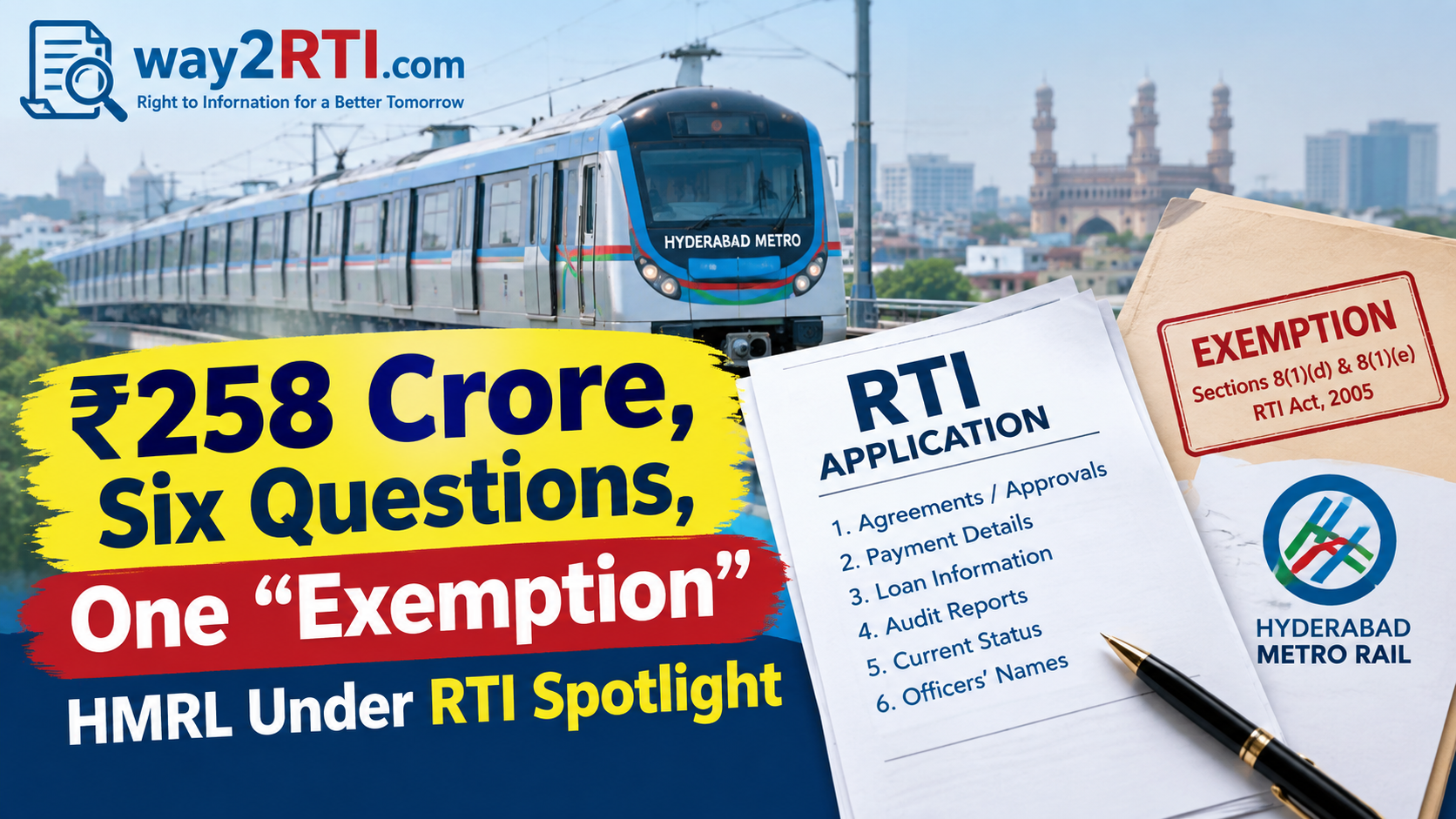
Hyderabad: An RTI reply issued by the Public Information Officer (PIO) of Hyderabad Metro Rail Limited (HMRL) has raised serious questions over transparency and disclosure of records relating to ₹258 crore in reported loan-related fees connected with Hyderabad Metro Rail Phase-I.
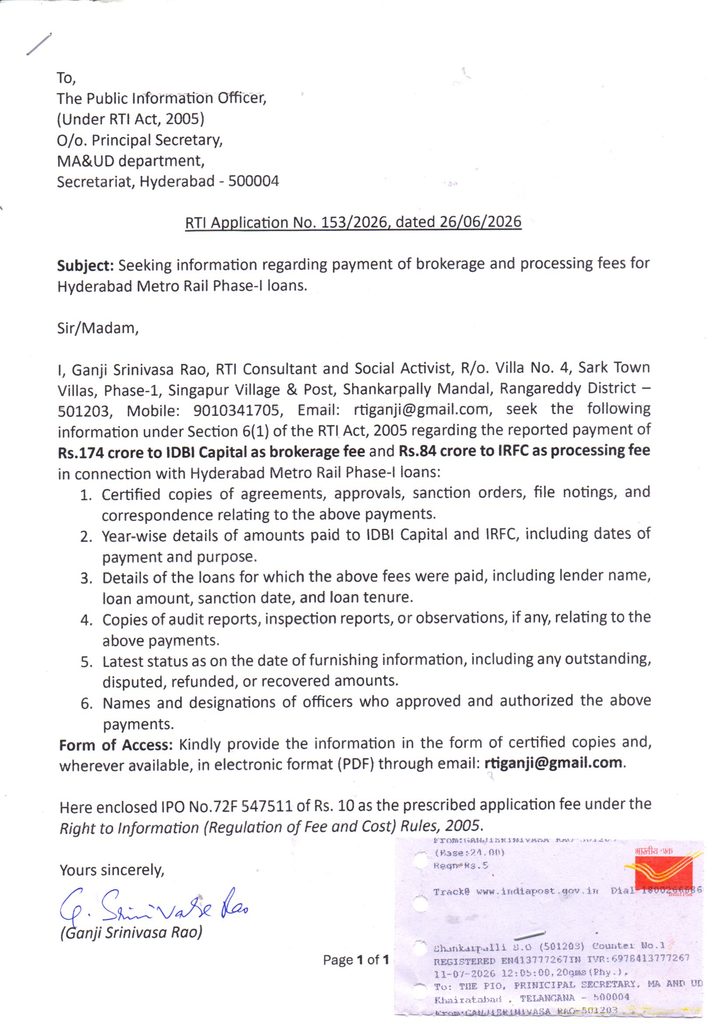
RTI applicant Ganji Srinivasa Rao had sought six specific categories of information concerning the reported payment of ₹174 crore to IDBI Capital as brokerage fee and ₹84 crore to IRFC as processing fee in connection with HMRL Phase-I loans.
Rao submitted the RTI application on 26 June 2026, sending it by Speed Post on 11 July 2026 to the Public Information Officer, Office of the Principal Secretary, Municipal Administration & Urban Development (MA&UD) Department, Telangana Secretariat.
Six specific questions
Rao sought certified copies of agreements, approvals, sanction orders, file notings and correspondence relating to the payments.
He also sought:
- Year-wise amounts paid to IDBI Capital and IRFC, including dates and purposes of payment;
- Details of the loans connected with the fees, including lenders, loan amounts, sanction dates and tenure;
- Audit or inspection reports and observations relating to the payments;
- The latest status of any outstanding, disputed, refunded or recovered amounts; and
- Names and designations of officers who approved and authorized the payments.
The applicant specifically requested certified copies and electronic PDF records wherever available.
Application transferred to HMRL
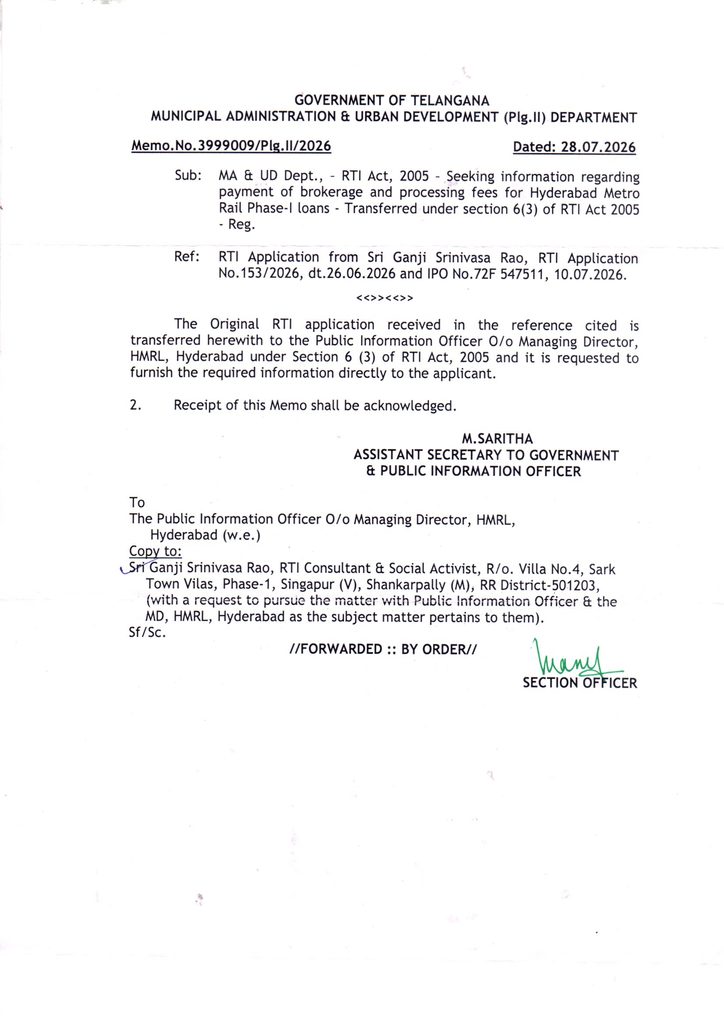
As the information was considered to pertain to HMRL, the MA&UD Department PIO transferred the application under Section 6(3) of the RTI Act, 2005 to the Managing Director, Hyderabad Metro Rail Limited.
The transfer was made through Memo No.3999009/Plg.II/2026, dated 28 July 2026.
However, the subsequent reply from HMRL has become the central issue.
HMRL PIO invokes RTI exemptions
The HMRL PIO, through Letter No. CPRO/MISC/40/2026-CPMW (1029593), dated 8 September 2026, stated that information concerning payment of ₹174 crore to IDBI Capital as brokerage fee and ₹84 crore to IRFC as processing fee in connection with HMRL Phase-I loans was exempt from disclosure under Sections 8(1)(d) and 8(1)(e) of the RTI Act, 2005.
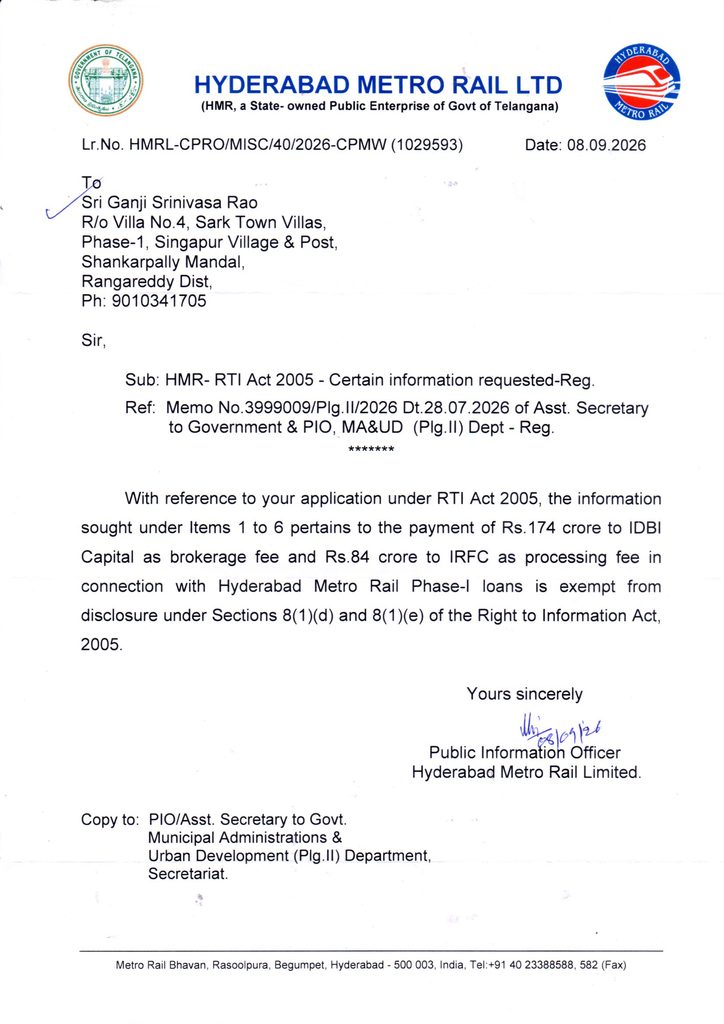
Rao received the reply on 10 September 2026.
According to Rao, the reply is misleading because his application did not merely seek confidential commercial information. He had specifically sought certified copies of agreements, approvals, sanction orders, file notings, payment details, audit observations and the identities/designations of approving officers.
The key question, therefore, is whether a blanket reliance on Sections 8(1)(d) and 8(1)(e) can lawfully cover every category of record sought in the six-point RTI application.
₹258 crore question remains unanswered
The RTI application concerns a combined reported amount of ₹258 crore:
₹174 crore — IDBI Capital brokerage fee
₹84 crore — IRFC processing fee
Rao argues that when public authorities deal with substantial public-sector infrastructure financing and expenditure, citizens have a legitimate interest in knowing how public funds were authorized, paid and accounted for.
The unanswered questions include: Who approved the payments? Under what agreements? For which loans? On what dates were the amounts paid? What audits or inspections examined the transactions? And is any amount outstanding, disputed, recovered or refunded?
Section 7(1) compliance questioned
Rao has also raised questions regarding compliance with Section 7(1) of the RTI Act, which requires the PIO to deal with an RTI request within the statutory period and communicate the decision, including reasons for rejection where access to information is denied.
In Rao’s view, merely citing exemption provisions without addressing the individual information points does not adequately explain why each category of requested record is exempt.
The issue is particularly important because the six points sought different types of information rather than one single document.
HMRL proactive disclosure under scrutiny
Rao has further examined HMRL’s RTI-related website https://hmrl.co.in/right-to-information/ disclosures and alleges that the required proactive suo-motu disclosure information under Section 4 of the RTI Act is not being comprehensively maintained and updated on the HMRL website.
He questions whether the information required to be disclosed proactively—including organizational, financial, decision-making and other relevant public-authority information—is being periodically updated as required.
This raises a broader issue: If information concerning public expenditure and decision-making is required to be disclosed proactively, why should a citizen have to pursue an RTI application merely to obtain basic records concerning major public financial transactions?
Rao has also alleged non-compliance with relevant DoPT Office Memorandum No.10/1/2013-IR, dated 6 October 2015, besides applicable Telangana Government orders and circulars concerning RTI implementation and proactive disclosure.
Accountability of the PIO and supervisory authorities
Rao has called upon the Chief Secretary, Telangana, and the Principal Secretary, MA&UD Department, to examine the matter and take appropriate action if violations of RTI obligations or applicable service/conduct rules are established.
He has specifically sought an inquiry into the conduct of the concerned PIO and the functioning of the HMRL RTI mechanism, including whether senior officials are adequately monitoring statutory RTI disclosures and website updates.
Rao has also referred to the Telangana Civil Services (Conduct) Rules, 1964 and G.O.Ms.No.114, GAD, dated 16 March 2009, requesting that appropriate action be considered wherever legally warranted.
Transparency test for HMRL
The controversy ultimately goes beyond one RTI application.
The issue is whether records concerning ₹258 crore in reported loan-related fees can be placed behind a broad exemption without examining each requested record independently and providing legally sustainable reasons for withholding it.
The case also raises a fundamental RTI principle: public authorities are expected to disclose information unless a specific exemption applies—not simply presume that an entire subject is confidential.
For Rao, the next question is straightforward:
Who authorized the ₹258 crore payments, under what terms, for which loans, and where are the supporting public records?
The answers could determine whether the HMRL RTI system is functioning as a mechanism of transparency—or becoming another barrier to accessing information about public expenditure.
Way2RTI.com will continue to track the matter and place relevant RTI records and official responses in the public domain in the interest of transparency and accountability.
Note: Are you interested in filing an RTI application on the above issue? Interested citizens may send their details to our official email: gsrao@way2rti.com or sms to 9010341705