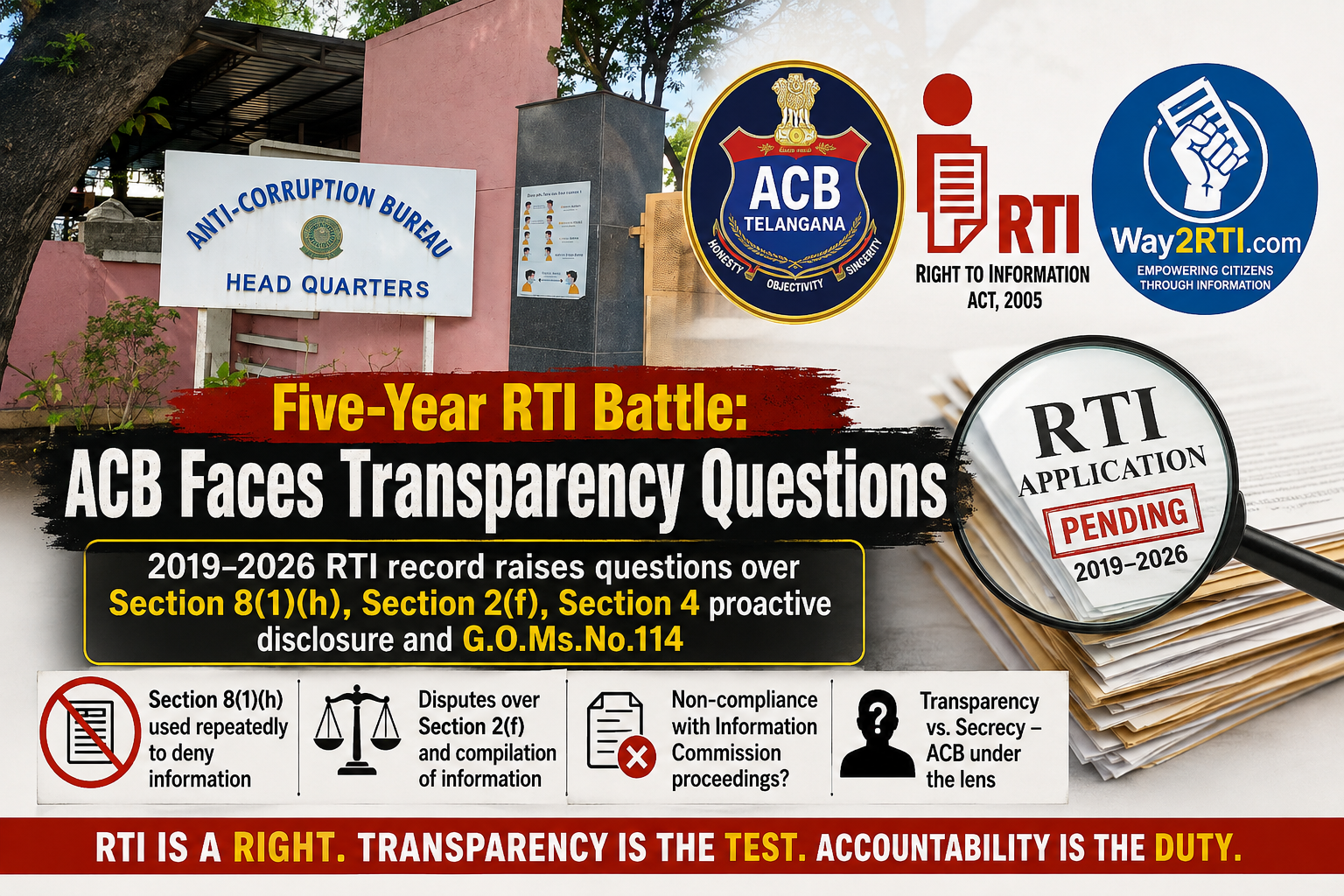
2019–2026 RTI record raises questions over Section 8(1)(h), Section 2(f), Section 4 proactive disclosure and G.O.Ms.No.114
The Right to Information Act, 2005 seeks to ensure transparency and accountability in public authorities. However, the nearly five-year RTI experience of Ganji Srinivasa Rao with the Office of the Director General, Anti-Corruption Bureau (ACB), Telangana, raises serious questions about access to full and accurate information.
From 2019 to 2026, his RTI applications concerning corruption cases, convictions, investigations and prosecution records have resulted in repeated disputes over Section 8(1)(h), Section 2(f), compilation of information and alleged non-compliance with Information Commission proceedings.
2019: Information denied under Section 8(1)(h)
On 20 June 2019, Rao sought ACB rules/GOs concerning suo motu cases and statistics from 2 June 2014 to June 2019, including cases registered, convictions, cases dropped and cases under investigation.
PIO P. Raghava Rao replied through Letter No.47/RTI/TS/2019 dated 25 July 2019, denying the information by invoking Section 8(1)(h).
The applicant questioned whether aggregate statistical information can automatically be denied on the ground that disclosure would impede investigation or prosecution.
2021: Category-wise ACB information sought
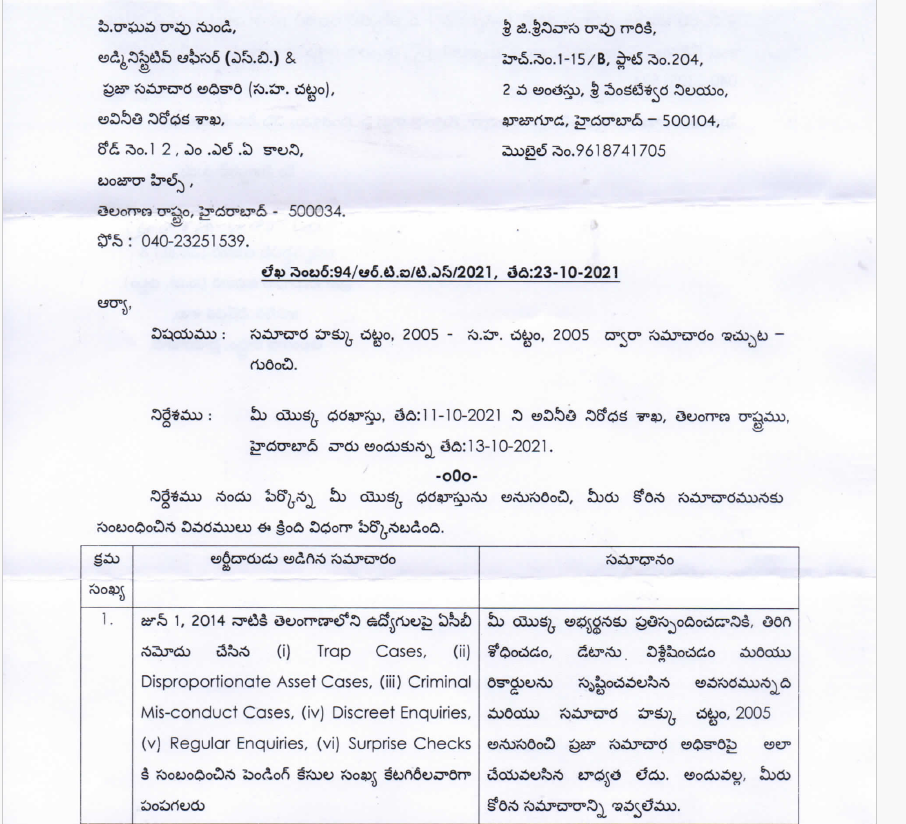
On 11 October 2021, Rao filed RTI Application No.166/2021, seeking:
- Pending cases before 2 June 2014;
- Cases registered from 2 June 2014 to September 2021;
- Trap Cases;
- Disproportionate Assets Cases;
- Criminal Misconduct Cases;
- Discreet and Regular Enquiries;
- Surprise Checks; and
- GOs relating to cases where further action was dropped.
The PIO replied through C.No.94/RTI/A2/2021 dated 23 October 2021, stating that the RTI Act does not require the authority to compile, recreate or reshape information into the format requested.
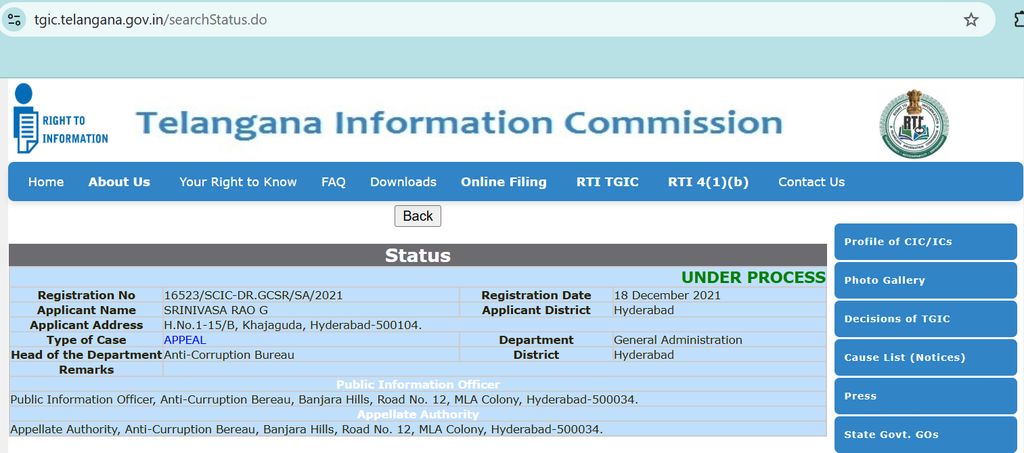
Rao subsequently approached the Telangana Information Commission.
2025–2026: Information Commission proceedings and alleged non-compliance
After nearly four years, the matter was heard on 9 September 2025.
According to Rao’s written submission, he appeared before the State Chief Information Commissioner and the PIO was orally directed to furnish the requested information within 15 days.
The applicant states that the information was not furnished.
On 2 December 2025, he again appeared before the Commission and, according to his account, was directed to meet the Director General, ACB.
Rao states that he met the DG on the same day but received no subsequent complete written disclosure.
The case was again called on 31 January 2026, with the applicant alleging continued non-compliance.
2022: ACB supplied 153 conviction statistics
A contrasting response came from RTI Application No.88/2022 dated 14 March 2022.
Through Letter No.26/RTI/TS/2022 dated 20 April 2022, the ACB supplied statistics showing 153 convictions of accused officers between 2 June 2014 and 8 April 2022:
| Category | Convictions |
| Trap Cases | 132 |
| Disproportionate Assets | 19 |
| Criminal Misconduct | 2 |
| Total | 153 |
The year-wise figures were also supplied.
The transparency question
If the ACB maintains and can provide category-wise conviction statistics, why are other category-wise datasets repeatedly described as requiring “creation”, “research” or “compilation”?
The answer depends on whether the requested information already exists in the records and whether a valid statutory exemption applies.
2026: Prosecution records again denied
On 16 February 2026, Rao filed RTI Application No.55/2026, seeking prosecution reports, sanction orders, officer details, GOs, case status, charge-sheet status, trial stage, court details and outcomes.
PIO Raghava Rao Putta replied through C.No.23/RTI/TG/2026 dated 6 March 2026.
Section 8(1)(h) was invoked for prosecution-related information, while Section 2(f) and the “creation/research/analysis” principle were relied upon for other information.
G.O.Ms.No.114: Full and Accurate Information Is a Government Duty
A further accountability issue arises under G.O.Ms.No.114, General Administration (Services-C) Department, dated 16 March 2009.
The order amended Rule 14 of the A.P. Civil Services (Conduct) Rules concerning Communication of Official Information. It states that every Government servant shall, in good faith, communicate to the public “full and accurate information” that can be disclosed under the RTI Act.
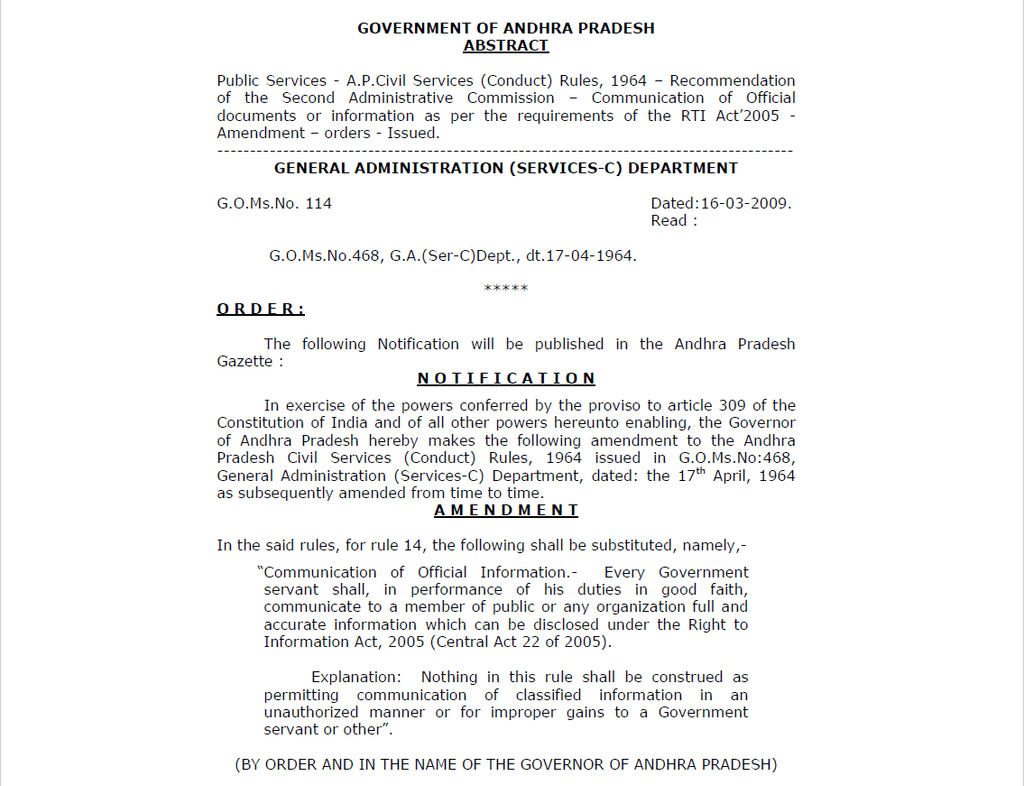
Therefore, where PIOs are alleged to have repeatedly denied, withheld or supplied incomplete, incorrect or misleading information, the matter may warrant examination not only under the RTI Act but also under the applicable service-conduct framework.
Importantly, G.O.Ms.No.114 does not make every RTI denial an offence. The competent authority must determine whether the information was legally disclosable and whether the official response was full and accurate.
Section 20: Accountability for Incorrect or Misleading Information
Section 20 of the RTI Act provides a separate mechanism concerning, among other matters, unreasonable refusal, malafide denial and knowingly providing incorrect, incomplete or misleading information.
If the applicant’s allegations are established from the original records, the competent Information Commission can examine whether Section 20 is attracted.
Section 4: What Is Being Proactively Disclosed?
The case also raises questions concerning Section 4 proactive disclosure.
The ACB should ensure that information required to be disclosed proactively is:
- Published;
- Complete;
- Accurate;
- Updated; and
- Easily accessible.
If information is already required to be placed in the public domain, citizens should not have to spend years obtaining it through RTI proceedings.
Where Does ACB Data Reported by Media Come From?
ACB statistics regularly appear in newspapers and other media.
This raises a legitimate public-interest question:
If ACB statistics are available to media organisations, from where are reporters obtaining them?
Possible sources include official press releases, briefings, annual reports, court records, Government documents or other official communications.
Way2RTI.com does not allege improper access by any media organisation. The question is one of transparency and equal access to public information.
Way2RTI.com Raises 7 Key Questions
- Why were some ACB statistics denied under Section 8(1)(h)?
- Why were category-wise requests described as “creation” or “compilation”?
- How was the 153-conviction figure compiled and supplied?
- What ACB information is proactively disclosed under Section 4?
- What happened after the alleged 9 September 2025 direction to furnish information?
- Were allegations of denial of full and accurate information examined under G.O.Ms.No.114?
- If ACB statistics are supplied to media, why is comparable information difficult for RTI applicants to obtain?
Conclusion
The RTI journey of Ganji Srinivasa Rao from 2019 to 2026 raises a broader question about transparency within an institution responsible for combating corruption.
The RTI Act does not require a PIO to create information that does not exist. But where existing records are held by a public authority, the legality of refusing access must be examined against the specific exemption and the actual records.
At the same time, G.O.Ms.No.114 requires Government servants to communicate full and accurate information that can lawfully be disclosed under the RTI Act.
After years of RTI proceedings, the fundamental question remains:
How much information does the Telangana ACB actually hold, how much is proactively disclosed, and why does obtaining legally disclosable information take years?
Way2RTI.com places these questions in the public domain for factual, administrative and legal scrutiny. Allegations against individual officials should be determined by the competent authorities on the basis of the original RTI applications, replies, records and applicable law.
Note: Are you interested in filing an RTI application on the above issue? Interested citizens may send their details to our official email: gsrao@way2rti.com