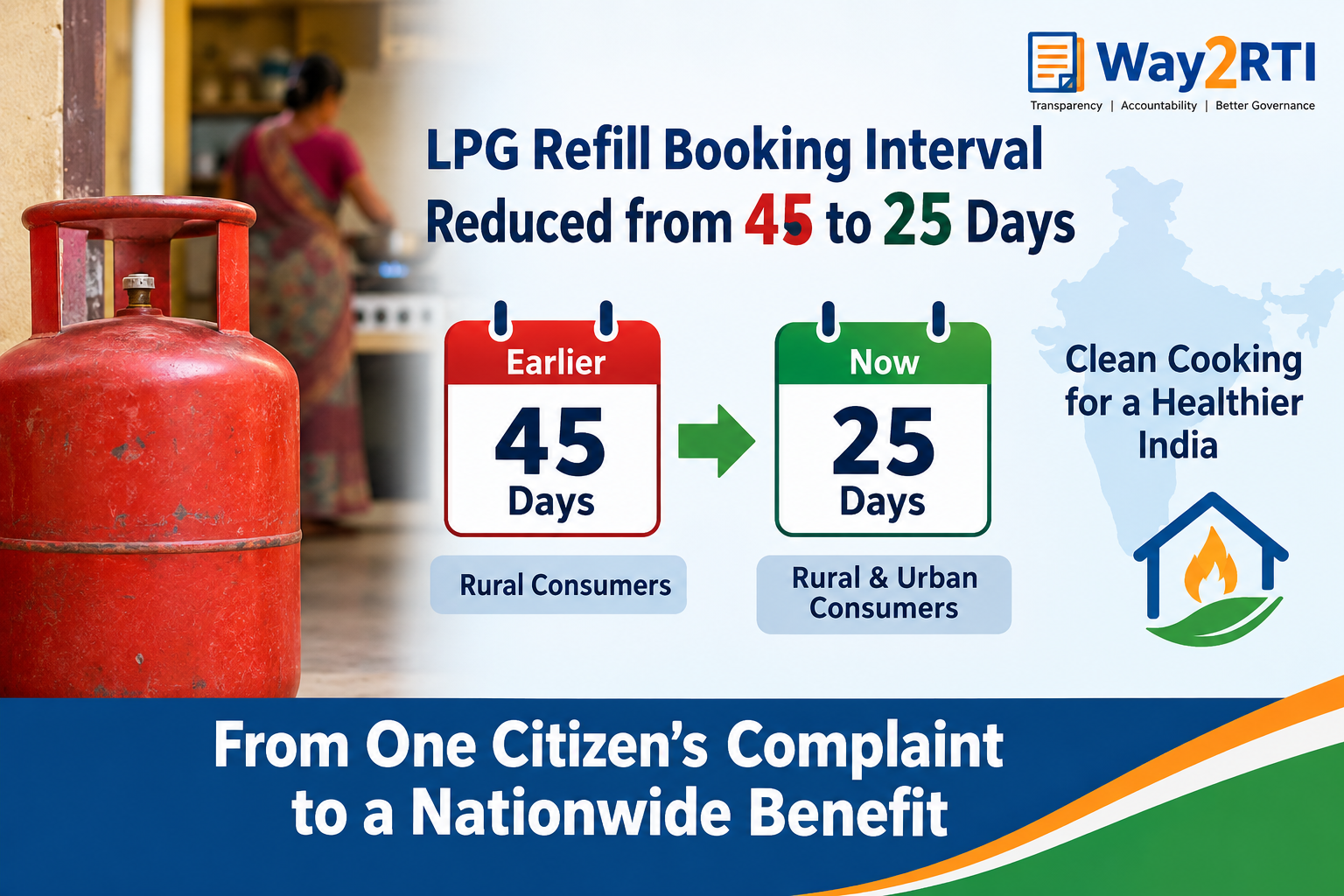
From a 45-day refill restriction faced by one family to a 25-day booking interval for rural and urban consumers across India
A routine household difficulty faced by a family in Telangana has become the starting point for a much larger public-interest development in India’s domestic LPG refill system.
Ganji Srinivasa Rao, an RTI consultant and social activist, says his family of five experienced difficulties in booking a domestic LPG refill after shifting from Khajaguda, near Gachibowli, to the Shankarpally municipal area.
While living in Khajaguda, the family was able to book LPG refills whenever required for regular household cooking. After shifting to Shankarpally, however, the family encountered a 45-day inter-refill booking restriction applicable to rural consumers during the LPG supply-management measures introduced in 2026.
The issue became particularly significant because LPG is an essential cooking fuel for the five-member household.
A message that raised the concern
When the family attempted to book a refill, it received an SMS from HPCL stating:
“Dear valued customer, your last refill was delivered on 23.06.2026, your next available booking date for a refill is 08.08.2026.”
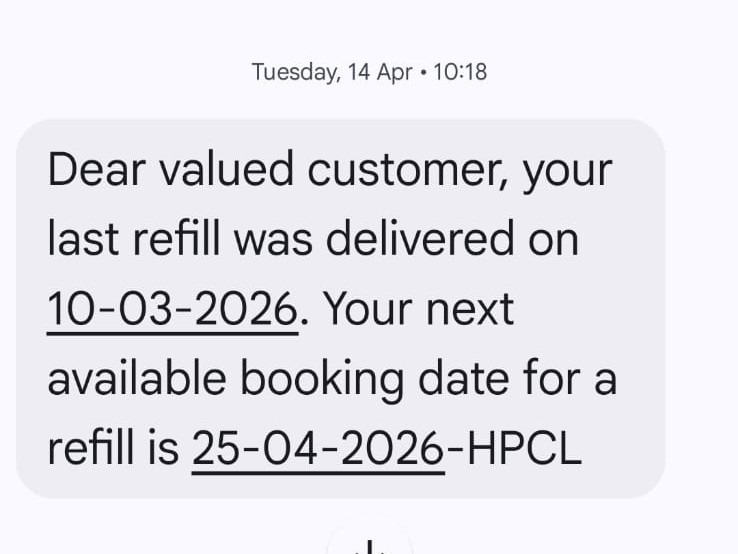
According to Rao, similar booking restrictions had been experienced by his family from March 2026 onwards.
Rather than treating the issue merely as a personal inconvenience, Rao approached the matter as a citizen-service deficiency affecting a wider section of consumers, particularly families living in rural and newly urbanising areas.
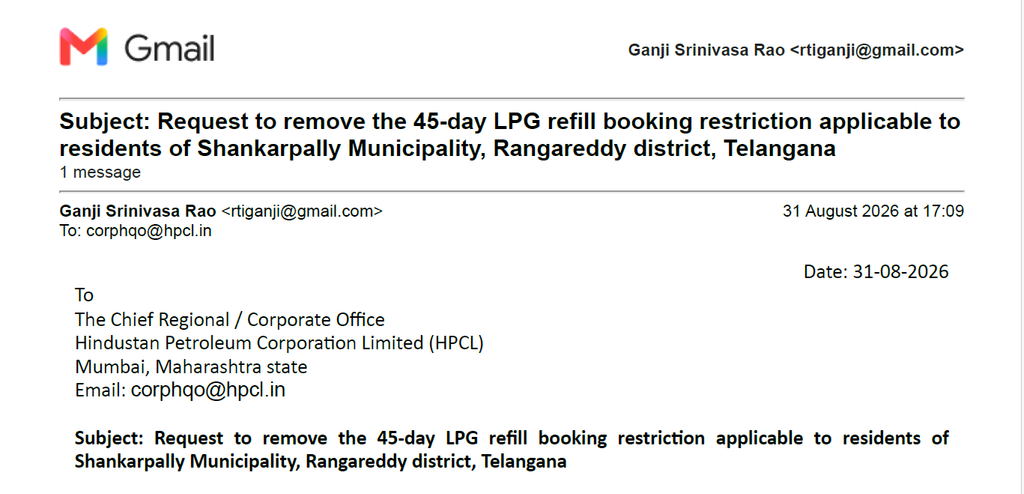
On 31 August 2026, he sent a complaint/representation by email to the Hindustan Petroleum Corporation Limited (HPCL) Corporate Office, Mumbai, seeking attention to the difficulty faced by domestic consumers.
The bigger question: Can an essential service have different waiting periods?
The issue was not simply about one LPG cylinder.
The central question was whether consumers using the same domestic LPG service should face significantly different booking intervals depending on whether they were classified as urban or rural consumers.
During the LPG supply pressures in March 2026, the Union Government had officially clarified that the applicable refill booking intervals were 25 days in urban areas and 45 days in rural areas, irrespective of connection type.
The Government subsequently introduced several measures to manage LPG demand and ensure equitable distribution during the supply situation.
For families dependent entirely on LPG for cooking, however, a 45-day booking interval could create practical difficulties when a cylinder was exhausted earlier.
September 8: Major nationwide change
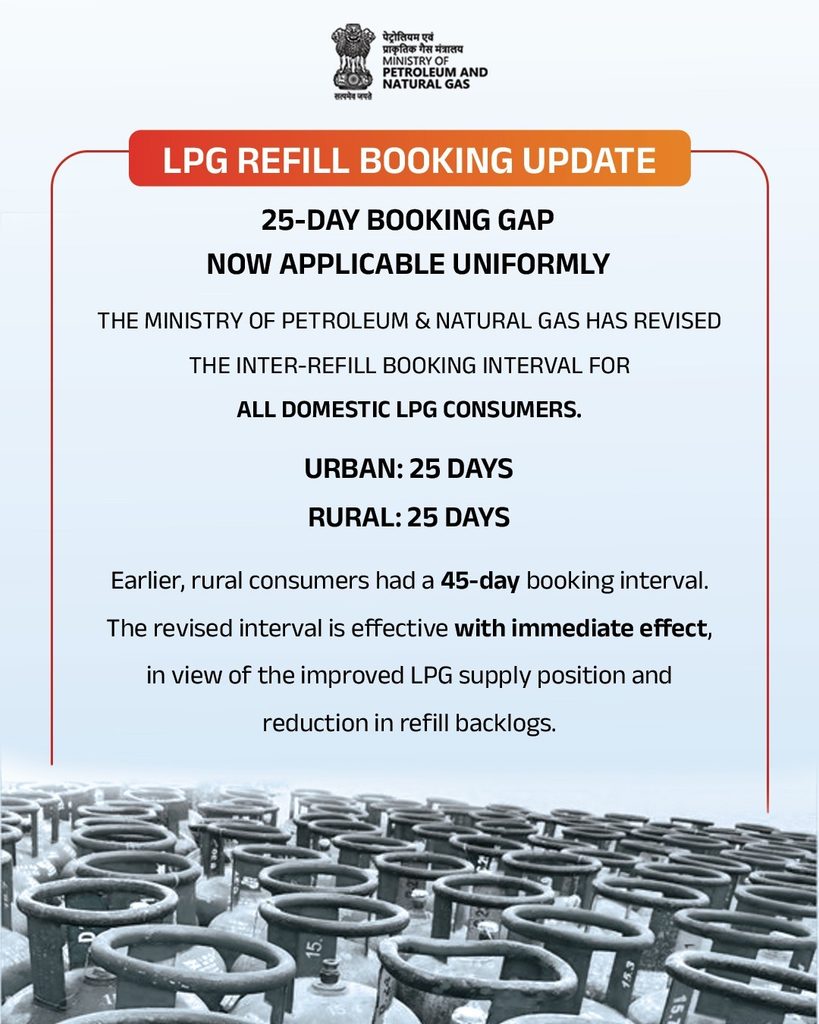
On 8 September 2026, the Ministry of Petroleum and Natural Gas announced a significant revision.
The inter-refill booking interval for domestic LPG consumers was revised to 25 days uniformly across both urban and rural areas, with immediate effect.
The Ministry stated that the earlier arrangement had been introduced in March 2026 amid the conflict in the Middle East, with a 25-day interval for urban consumers and 45 days for rural consumers.
With the LPG supply position improving and refill backlogs considerably reduced, the Government has now removed the rural-urban distinction.
Therefore:
Urban consumers: 25 days
Rural consumers: 25 days
The three major Oil Marketing Companies — Indian Oil Corporation Limited (IOCL), Bharat Petroleum Corporation Limited (BPCL) and Hindustan Petroleum Corporation Limited (HPCL) — have been advised to implement the revised interval uniformly across India.
From an individual complaint to a larger public benefit
It would be inappropriate to claim that one individual complaint alone caused the Government’s policy change.
The decision was part of a broader national review of LPG supply, demand, availability and refill backlogs.
However, Rao’s experience demonstrates the importance of responsible citizenship: identifying a problem, documenting the deficiency, approaching the concerned authority and seeking a systemic solution rather than accepting an inconvenience as unavoidable.
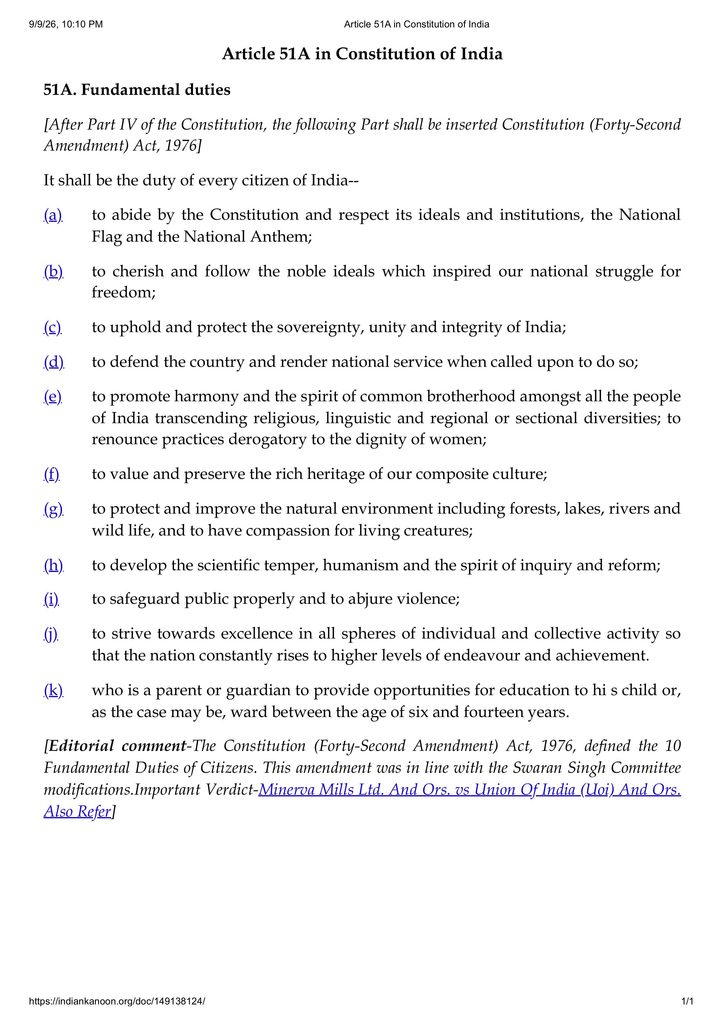
This is the essence of Article 51A of the Constitution of India, which sets out fundamental duties of citizens, including the duty to promote harmony, protect public property and strive towards excellence in individual and collective activity.
For Rao, the LPG booking problem became a public-interest issue because thousands and potentially millions of other families could face similar difficulties.
More than 33 crore LPG connections
The potential significance of the decision is substantial.
According to Government data, the number of LPG connections in India increased from 14.52 crore in 2014 to 33.39 crore in 2026. More than 10.57 crore LPG connections have been provided under the Pradhan Mantri Ujjwala Yojana (PMUY) as of May 2026.
PMUY has particularly expanded access to clean cooking fuel among economically vulnerable households and has had a major impact in rural India.
However, 10.57 crore PMUY connections should not be treated as the total number of rural LPG connections. They represent PMUY connections, whereas India’s overall LPG consumer base includes both PMUY and non-PMUY domestic consumers.
Therefore, the 25-day uniform booking interval has relevance far beyond PMUY beneficiaries.
Why this matters to ordinary families
For an LPG-dependent household, the refill cycle directly affects daily life.
A family may not consume one cylinder at exactly the same rate every month. Consumption can increase because of:
- More family members staying at home
- School and college holidays
- Guests and family functions
- Increased cooking requirements
- Seasonal changes
- Households without alternative cooking fuels
A rigid 45-day booking restriction could therefore create difficulties for consumers whose cylinder became empty before the permitted booking date.
The revised 25-day rule provides greater flexibility and brings rural consumers onto the same booking schedule as urban consumers.
The larger lesson: Citizens can raise service deficiencies
The LPG episode provides a broader lesson for public administration.
A citizen does not always have to wait for a major government programme or court intervention to raise a public-service problem.
A consumer who identifies a genuine deficiency can:
Identify → Document → Complain → Follow up → Seek systemic correction
That process can help convert an individual grievance into a public-interest intervention.
Ganji Srinivasa Rao’s LPG experience is therefore not merely a story about one family’s cooking gas refill.
It is a story about how responsible citizenship, persistence and formal representation can bring attention to a service issue affecting a much larger section of society.
Way2RTI Public Interest View
The latest decision is a welcome step towards equal treatment of domestic LPG consumers.
The Government has now established a simple principle:
Rural or urban — domestic LPG consumers can book their next refill after 25 days.
For millions of households, a change that appears administrative on paper can make a significant difference in everyday life.
One family’s problem became a question of public interest. A nationwide solution followed.
Way2RTI.com will continue to highlight how citizens can identify deficiencies in public services, use lawful grievance mechanisms and seek solutions in the larger public interest.
Note: Are you interested in filing an RTI application on the above issue? Interested citizens may send their details to our official email: gsrao@way2rti.com