Unlocking Constituency Funds: A Transparency Report for Jubilee Hills Voters
Hyderabad: How much public money has been allocated for development in the Jubilee Hills Assembly Constituency? Where has it been spent, which works were taken up, and how much remains pending?
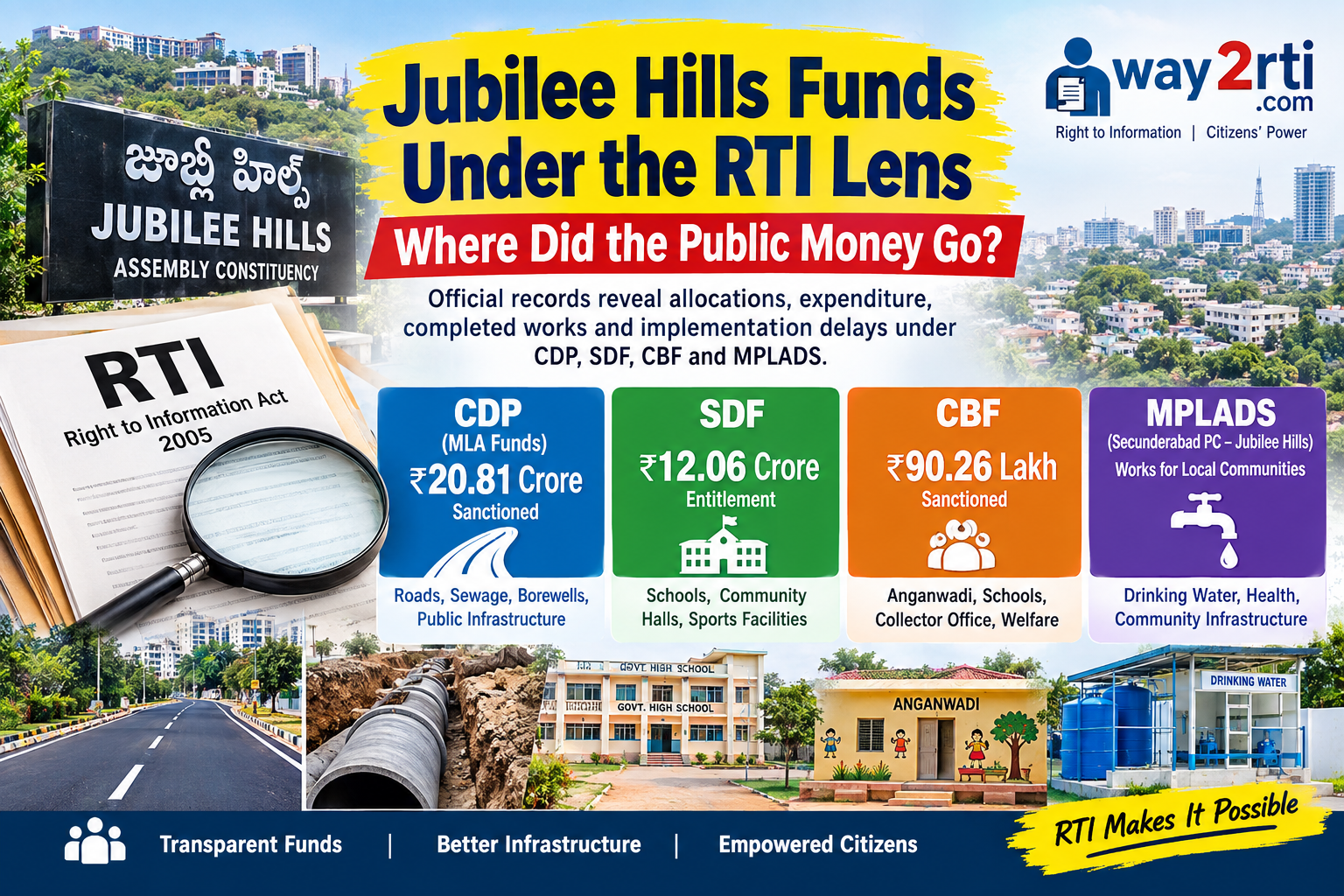
Official records obtained under the Right to Information Act, 2005, from the Chief Planning Officer, Hyderabad District, provide a picture of expenditure under four major discretionary development schemes: Constituency Development Programme (CDP/MLA Funds), Special Development Fund (SDF), Crucial Balancing Fund (CBF), and Members of Parliament Local Area Development Scheme (MPLADS).
The records show substantial spending on roads, sewerage, drinking water, schools, Anganwadi centres and community infrastructure, while also highlighting delays in the implementation of several SDF projects.
CDP: More Than ₹20 Crore Sanctioned
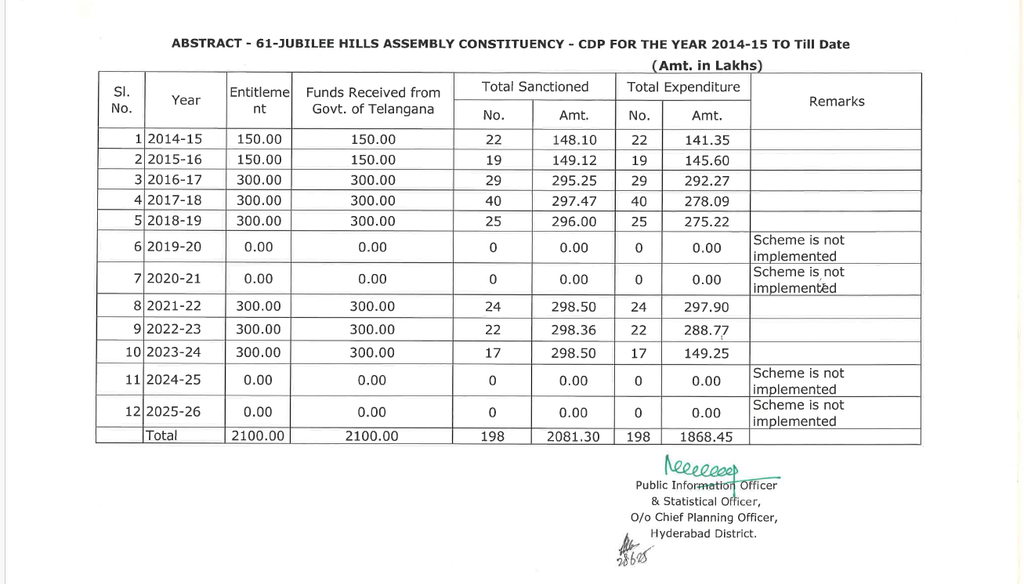
Under the Constituency Development Programme, a total of ₹20.81 crore was sanctioned for works in Jubilee Hills.
According to the RTI information:
- Total sanctioned: ₹20,81,30,403
- Expenditure released: ₹18,68,44,545
- Major focus: Sewerage pipelines, CC roads, borewells and public infrastructure.
A significant share of the CDP works focused on basic civic infrastructure in densely populated localities.
Works included laying 250 mm to 600 mm SWG sewerage pipelines and restoration of CC roads in areas including Yousufguda, Rahmath Nagar, Vengal Rao Nagar, Erragadda and Borabanda.
The records indicate that more than 90% of CDP works had been completed, while some works sanctioned during 2023–24 were still under progress at the time of the RTI response.
SDF: ₹12.06 Crore Entitlement, but Execution Raises Questions
The Special Development Fund presents a different picture.
For the period 2014–15 to 2025–26, the Jubilee Hills constituency had an entitlement of ₹12.06 crore.
Of this:
- Funds received: ₹11.63 crore
- Total sanctioned: ₹7.57 crore
- Projects sanctioned: 15
- Expenditure on completed works: ₹1.97 crore
The RTI records also state that the scheme was not implemented during 2019–20, 2020–21, 2024–25 and 2025–26.
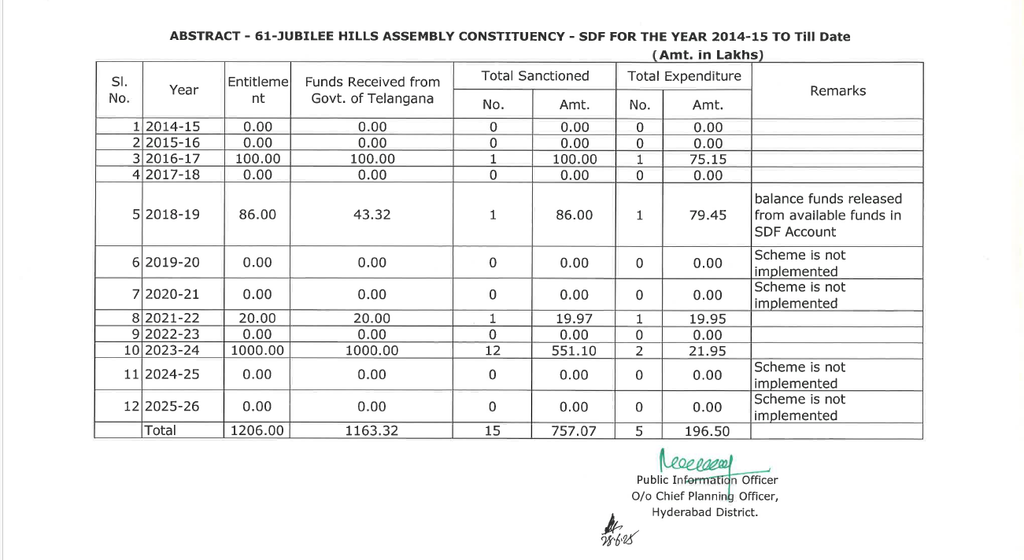
A particularly significant issue is the status of projects sanctioned during 2023–24. According to the information supplied, works involving approximately ₹5.51 crore were still shown as in progress, with no expenditure released against those works at the time of the RTI response.
These projects reportedly included infrastructure improvements for government schools and sports-related facilities, including works associated with the KVBR Sports Stadium.
For voters, the important question is not merely how much was sanctioned, but how quickly sanctioned public funds were converted into completed public assets.
CBF: Nearly ₹90 Lakh Sanctioned, ₹88 Lakh Spent
The Crucial Balancing Fund records cover the period 2015–16 to 2022–23.
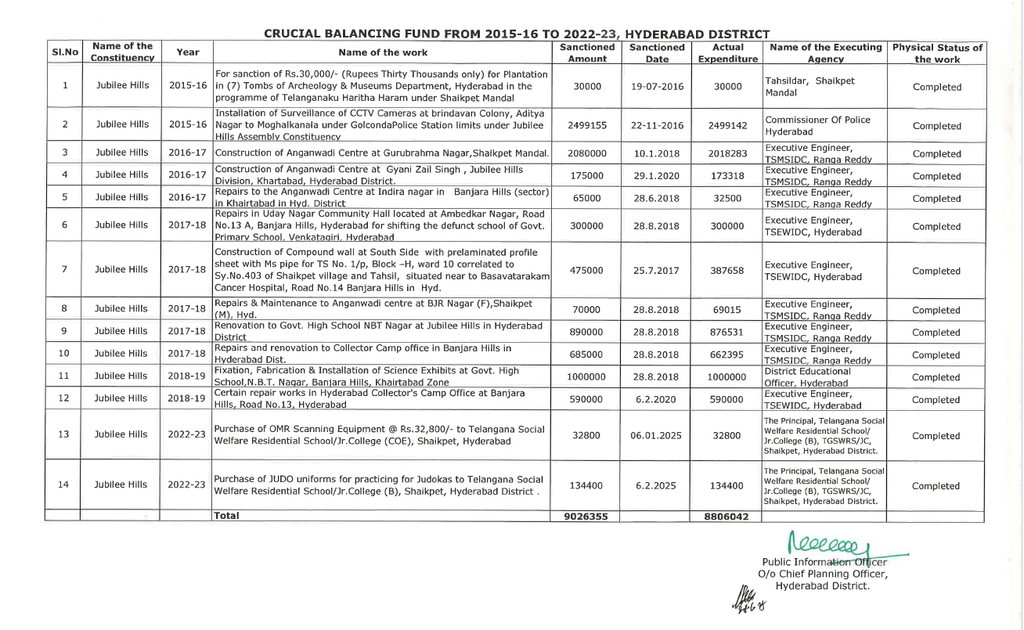
A total of ₹90.26 lakh was sanctioned for 14 projects, while expenditure stood at approximately ₹88.06 lakh.
The works included:
- Anganwadi centre construction and repairs
- Government school improvements
- Repairs to the Collector Camp Office
- Community and welfare-related works
The records indicate a high level of completion for the CBF-funded works.
Projects included improvements to Anganwadi centres in areas such as Gurubrahma Nagar, Gyani Zail Singh Nagar and Indira Nagar, along with renovation works at Government High School, NBT Nagar.
MPLADS: Parliament Funds Reach Local Infrastructure
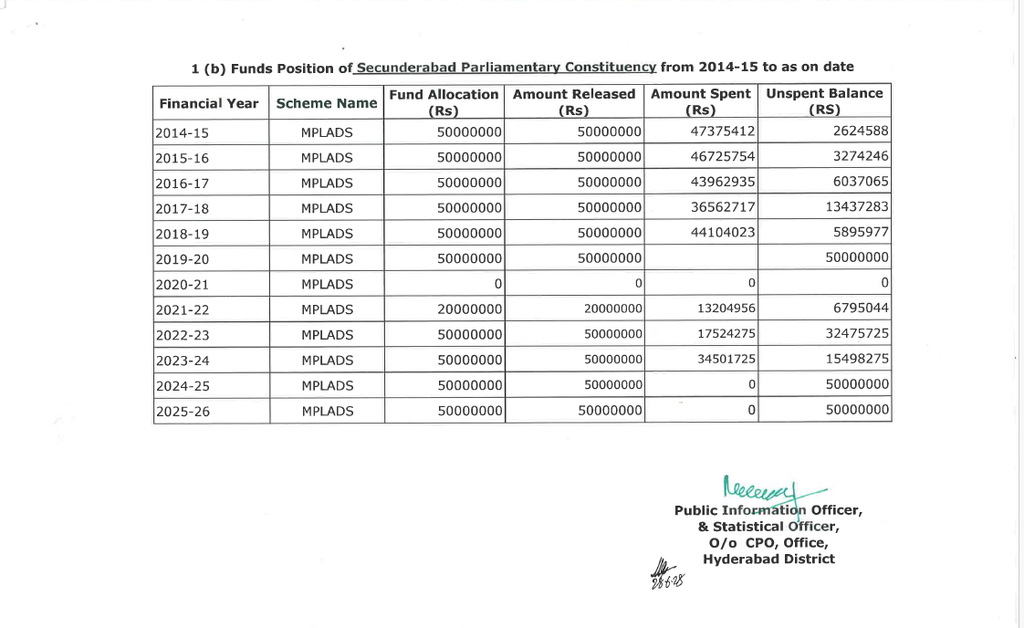
Jubilee Hills also received development works under the Members of Parliament Local Area Development Scheme (MPLADS) relating to the Secunderabad Parliamentary Constituency.
The RTI records identify contributions associated with former MPs Bandaru Dattatreya during the 16th Lok Sabha and G. Kishan Reddy during the 17th Lok Sabha.
The works included:
- Drinking-water borewells
- Community halls
- Graveyard compound walls
- Urban health-centre infrastructure
- Public-health facilities
- Infrastructure in SC/ST and weaker-section localities
Several works were aimed at addressing basic infrastructure requirements in communities that have historically faced gaps in public amenities.
Where Did the Money Go?
The RTI records reveal four broad priorities in Jubilee Hills.
1. Sewerage and Roads
Sewerage infrastructure appears to have been one of the largest areas of CDP expenditure.
The laying of SWG pipelines and subsequent CC-road restoration addressed basic urban infrastructure requirements in localities including Yousufguda, Borabanda, Erragadda and Vengal Rao Nagar.
2. Education and Child Welfare
Government schools and Anganwadi centres received attention through CBF and other development allocations.
Works included building repairs, renovation and infrastructure improvements. Equipment-related expenditure was also recorded, including items such as an OMR scanner and sports equipment.
3. Community Infrastructure
Public funds were also used for community-oriented infrastructure, including community halls, open gyms and buildings associated with various organisations.
4. Water, Sanitation and Public Health
Borewells, PVC water-storage tanks, RO drinking-water plants, public toilets and infrastructure at Urban Primary Health Centres were among the works taken up.
These works were particularly relevant to weaker-section and SC/ST localities.
What Should Jubilee Hills Voters Ask?
The RTI data provides more than a list of sanctioned works. It gives voters an opportunity to examine public expenditure against actual delivery.
Five questions emerge from the records:
1. How many sanctioned works have actually been completed?
2. How much money has been released against each sanctioned work?
3. Why were several SDF projects sanctioned in 2023–24 still pending?
4. Are the completed works physically available and functioning as intended?
5. What happened to the annual SDF entitlement during years when the scheme was reported as not implemented?
These questions can be answered through further RTI applications seeking work-wise sanctions, administrative approvals, technical sanctions, bills, measurement records, completion certificates, photographs and expenditure details.
Transparency Is More Than Allocation
For voters, a budget figure alone does not establish development.
A complete transparency assessment requires three stages:
Allocation → Expenditure → Public Asset
Money sanctioned must ultimately translate into a functioning road, sewer line, drinking-water facility, school, Anganwadi centre, health facility or community asset.
The RTI records show that Jubilee Hills has received substantial public funding through multiple development schemes. They also show that implementation and utilization have not been uniform across schemes.
The next step for citizens is therefore to move beyond asking “How much was sanctioned?” and ask:
“What was built, where was it built, how much was actually spent, and is the public getting the intended benefit?”
That is where the Right to Information Act becomes a powerful tool for constituency-level accountability.
Way2RTI.com | Information through RTI, Accountability through Citizens
Note: Are you interested in filing an RTI application on the above issue? Interested citizens may send their details to our official email: gsrao@way2rti.com