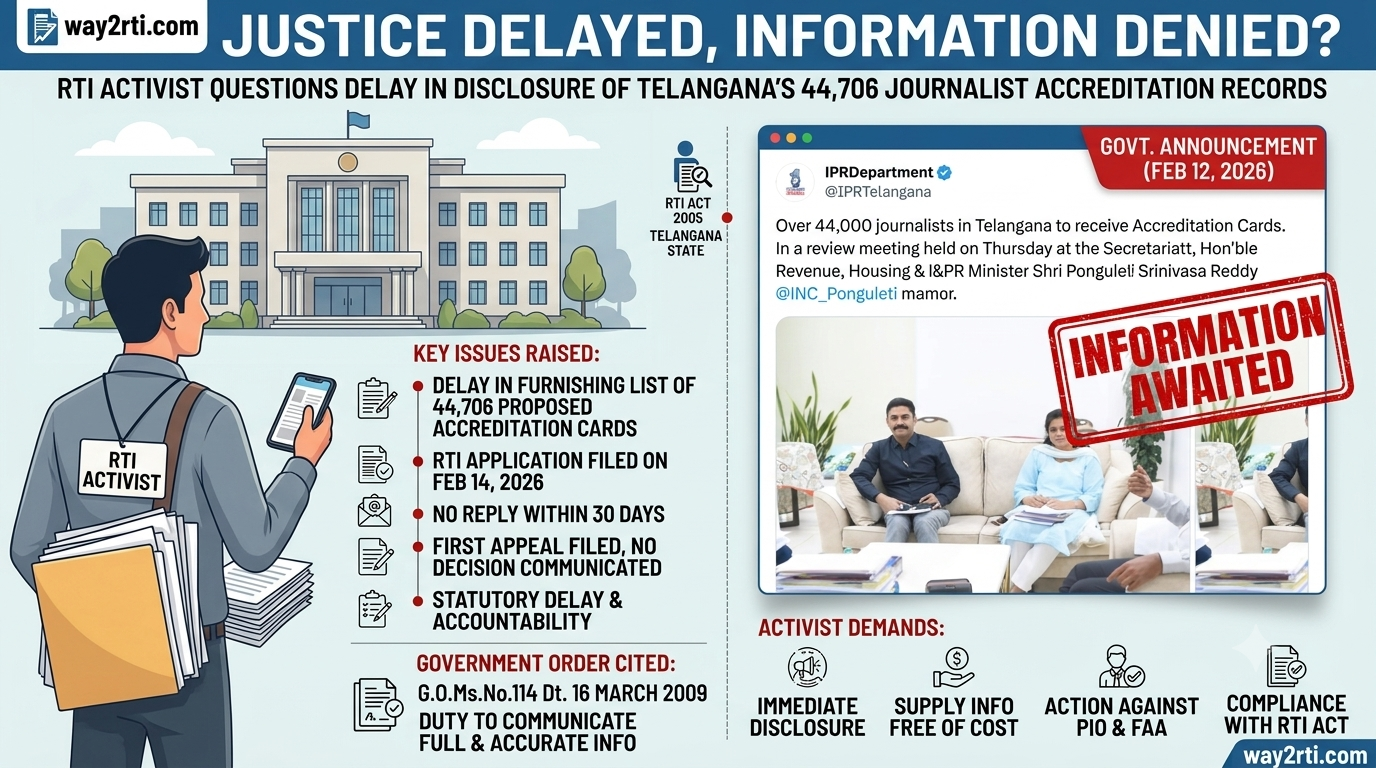
RTI Activist Questions Delay in Disclosure of Telangana’s 44,706 Journalist Accreditation Records
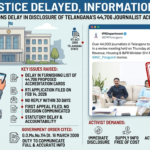
RTI Consultant and Social Activist Ganji Srinivasa Rao has raised serious concerns over the alleged delay by the Telangana Information & Public Relations (I&PR) Department in furnishing information sought under the Right to Information Act, 2005, relating to the Government’s announcement of 44,706 journalist accreditation cards.
On 14 February 2026, Rao filed RTI Application No.53/2026 under Section 6(1) before the Public Information Officer (PIO), Office of the Commissioner, I&PR Department, A.C. Guards, Hyderabad. The application was sent by Speed Post on the same day.
The RTI sought the complete official list of the 44,706 proposed/approved accreditation cards, including journalists’ names, accreditation numbers, media organisations, category, level, district/constituency/mandal, date of issue and validity. It also sought year-wise expenditure incurred by the Government on accreditation cards and details of officials responsible for maintaining the records.
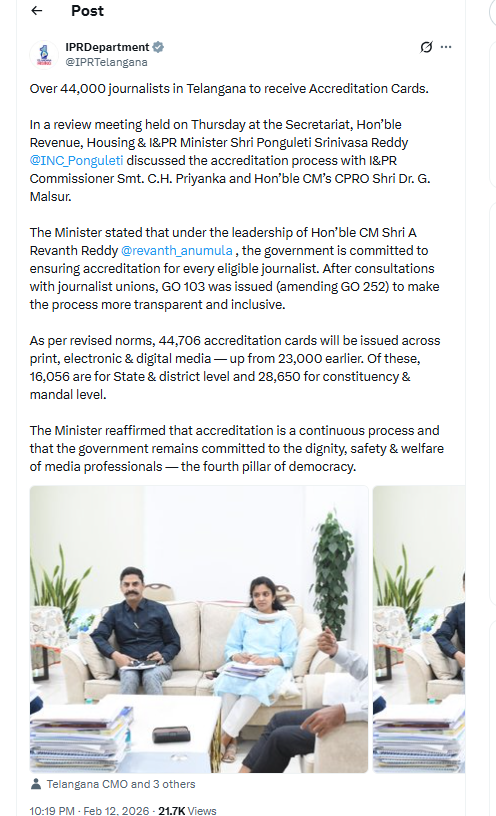
Government announcement of 44,706 accreditation cards
The application referred to an official I&PR Department social-media announcement dated 12 February 2026, stating that, under revised norms through G.O.Ms.No.103 amending G.O.Ms.No.252, a total of 44,706 accreditation cards would be issued across print, electronic and digital media—an increase from the earlier figure of 23,000.
The announcement stated that:
- 16,056 cards were for State and District level; and
- 28,650 cards were for Constituency and Mandal level.
No reply within 30 days
According to Rao, the PIO did not furnish the requested information within the statutory period prescribed under Section 7(1) of the RTI Act, which generally requires a response within 30 days.
He subsequently filed a First Appeal under Section 19(1) on 16 June 2026, again through Speed Post. He states that, despite the appeal, no effective order directing disclosure was communicated within the statutory appellate period.
Under Section 19(6), the First Appellate Authority is required to dispose of the appeal within the prescribed period. Where information is not furnished within the statutory time limit, Section 7(6) provides for furnishing the information free of charge.
G.O.Ms.No.114: Duty to communicate full and accurate RTI information
The matter also brings into focus G.O.Ms.No.114, General Administration (Services-C) Department, dated 16 March 2009, issued by the then Government of Andhra Pradesh.
The order amended Rule 14 of the A.P. Civil Services (Conduct) Rules, 1964, under the heading “Communication of Official Information.” It provided that every Government servant, while performing duties in good faith, shall communicate to a member of the public or any organisation full and accurate information which can be disclosed under the RTI Act, 2005.
The same provision clarified that it does not authorise the unauthorised communication of classified information or disclosure for improper gains.
The order was circulated to all Departments of the Secretariat, Heads of Departments and District Collectors, among other authorities.
A significant administrative principle
G.O.Ms.No.114 is significant because it expressly links the conduct obligations of Government servants with the requirements of the RTI Act, 2005.
Therefore, where information is legally disclosable under the RTI Act, the principle contained in the order emphasises the importance of providing full and accurate information, rather than incomplete or misleading information.
However, since the uploaded document is an Andhra Pradesh Government Order issued in 2009, its present applicability to Telangana Government employees should be determined with reference to the post-bifurcation legal and administrative position. The existence and contents of G.O.Ms.No.114 themselves do not, by themselves, establish that it presently governs every Telangana Government employee.
Question of statutory accountability
The matter raises an important question of public accountability:
When a public authority possesses information relating to a Government announcement and fails to furnish legally disclosable information within the statutory RTI period, who is responsible for the delay?
The RTI Act provides a specific mechanism for determining responsibility.
Under Section 20(1), the Information Commission may impose a penalty of ₹250 per day, subject to a maximum of ₹25,000, where the PIO, without reasonable cause, fails to furnish information within the prescribed period or otherwise contravenes the provisions of the Act.
Further, Section 20(2) permits recommendation for disciplinary action where the conduct of the PIO warrants such action.
Whether the delay was deliberate, negligent or supported by reasonable cause is a matter to be determined by the competent Information Commission after giving the concerned officer an opportunity to explain. Mere delay does not automatically establish criminal liability or make the concerned officials “accused”.
Public interest in accreditation data
The issue assumes significance because the Government itself publicly announced the figure of 44,706 journalist accreditation cards.
If such records are maintained by the I&PR Department, the RTI applicant contends that there should be transparency regarding:
- the basis for arriving at 44,706;
- the official list of accredited journalists;
- category-wise and level-wise distribution;
- accreditation numbers and validity;
- Government expenditure; and
- officials responsible for maintaining the records.
The RTI Act, particularly Sections 4(1)(a) and 4(1)(b), also places obligations concerning proper record maintenance and proactive disclosure.
RTI activist’s position
Rao contends that the issue is not merely about his individual RTI application but concerns transparency in a Government-administered accreditation system involving thousands of journalists and public expenditure.
He seeks:
- Immediate furnishing of the complete information sought in RTI Application No.53/2026;
- Supply of information free of cost under Section 7(6) because of the delay;
- Determination of responsibility for the statutory delay;
- Consideration of penalty proceedings under Section 20(1), wherever legally warranted;
- Consideration of disciplinary action under Section 20(2), if legally justified; and
- Appropriate directions by the First Appellate Authority/competent Information Commission for compliance with the RTI Act.
He also points to the principle reflected in G.O.Ms.No.114 that Government servants should communicate full and accurate information that can lawfully be disclosed under the RTI Act, subject to verification of the order’s present applicability to Telangana.
The legal position
The Right to Information Act, 2005 creates a statutory mechanism for citizens to obtain information held by public authorities.
The PIO has a statutory obligation to deal with an RTI application within the prescribed period, while appellate authorities have corresponding responsibilities under Sections 19(1) and 19(6).
The additional principle contained in G.O.Ms.No.114 is relevant to the broader question of Government accountability because it specifically required Government servants, under the then A.P. Conduct Rules, to communicate full and accurate information that could be disclosed under the RTI Act.
Accordingly, the present matter should primarily be examined as an issue of statutory compliance, transparency, record management and administrative accountability, without prematurely labelling any officer as an “accused”.
If no reasonable cause is established for the RTI delay, the competent Information Commission may consider the consequences specifically provided under Sections 19 and 20 of the RTI Act, 2005.
Note: Are you interested in filing an RTI application on the above issue? Interested citizens may send their details to our official email: gsrao@way2rti.com