Multi-Crore CMR Defaults in Karimnagar District
RTI Uncovers Multi-Crore CMR Defaults in Karimnagar District
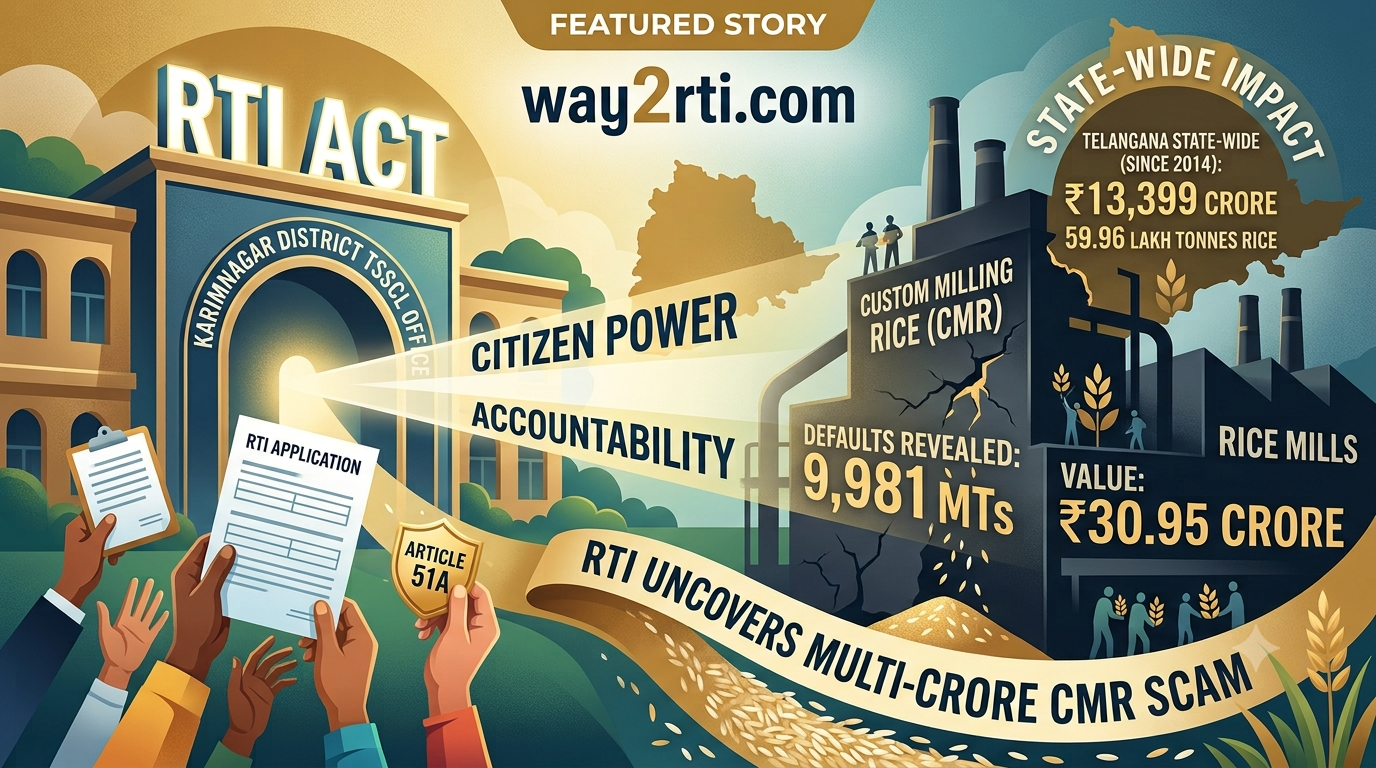
RTI response reveals 9,981 MT of defaulted rice valued at ₹30.95 crore
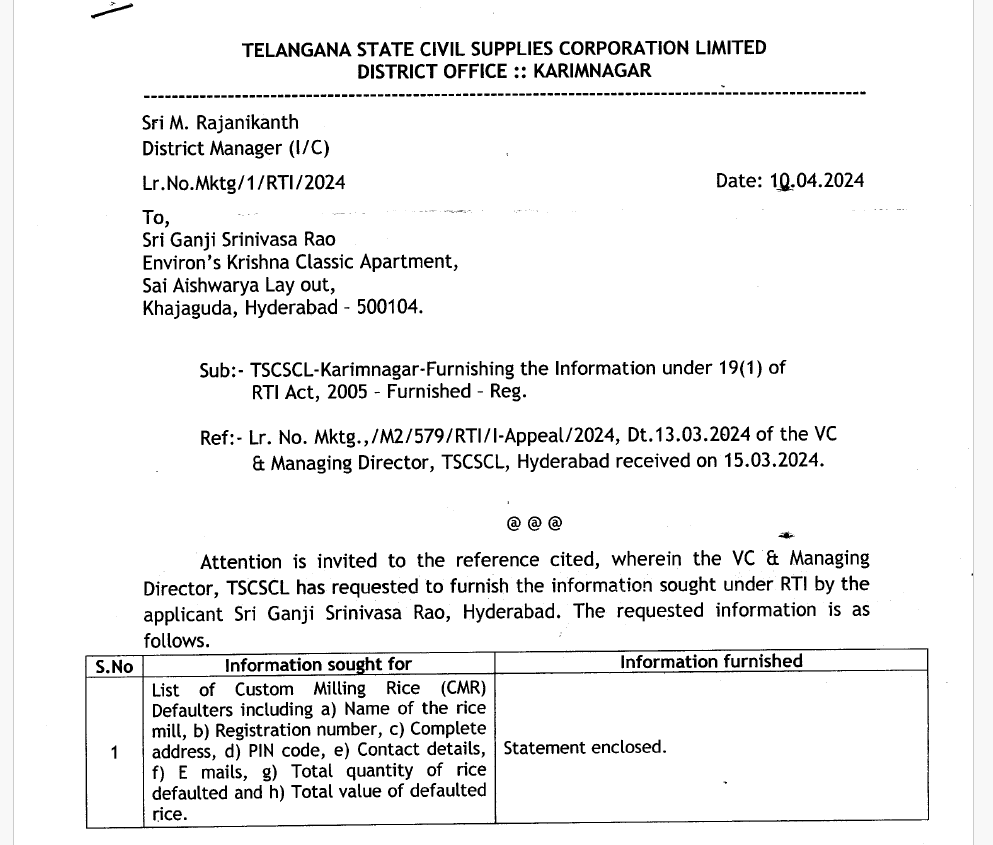
Karimnagar, Telangana: An RTI response obtained by social activist Sri Ganji Srinivasa Rao has brought to light the extent of Custom Milled Rice (CMR) defaults in Karimnagar district, revealing nearly 10,000 metric tonnes of defaulted rice with a stated value of ₹30.95 crore.
Rao had originally submitted the RTI application to the Commissioner of Civil Supplies and Managing Director, Telangana State Civil Supplies Corporation Limited (TSCSCL). The authorities subsequently directed the concerned district-level officials to furnish the information.
In response, Sri M. Rajanikanth, District Manager (Incharge), TSCSCL, Karimnagar, provided details concerning rice mills and traders against whom CMR quantities were shown as defaulted.
Karimnagar CMR Default Totals
According to the RTI information:
- Total Quantity of Defaulted Rice: 9,981.284 Metric Tonnes (MTs)
- Total Value of Defaulted Rice: ₹30,94,80,634.31
- Approximate Value: ₹30.95 Crore
The figures indicate a substantial quantity of government-linked rice remaining unaccounted for or outstanding against CMR obligations in the district, according to the official information furnished under the RTI Act.
Top 3 Largest Defaults in Karimnagar District
1. Pavanasutha Trds C/o Lalitha Inds MRM — Molangur
Defaulted Rice: 1,574.810 MTs
Stated Value: ₹5,48,30,632.00
2. Sai Traders C/o Jagan Matha — Bornapalli
Defaulted Rice: 631.356 MTs
Stated Value: ₹2,19,82,111.00
3. Vamshi Inds — PP. Pally
Defaulted Rice: 543.767 MTs
Stated Value: ₹1,89,32,499.00
These three entities alone account for approximately 2,749.933 MTs of the defaulted rice identified in the RTI response.
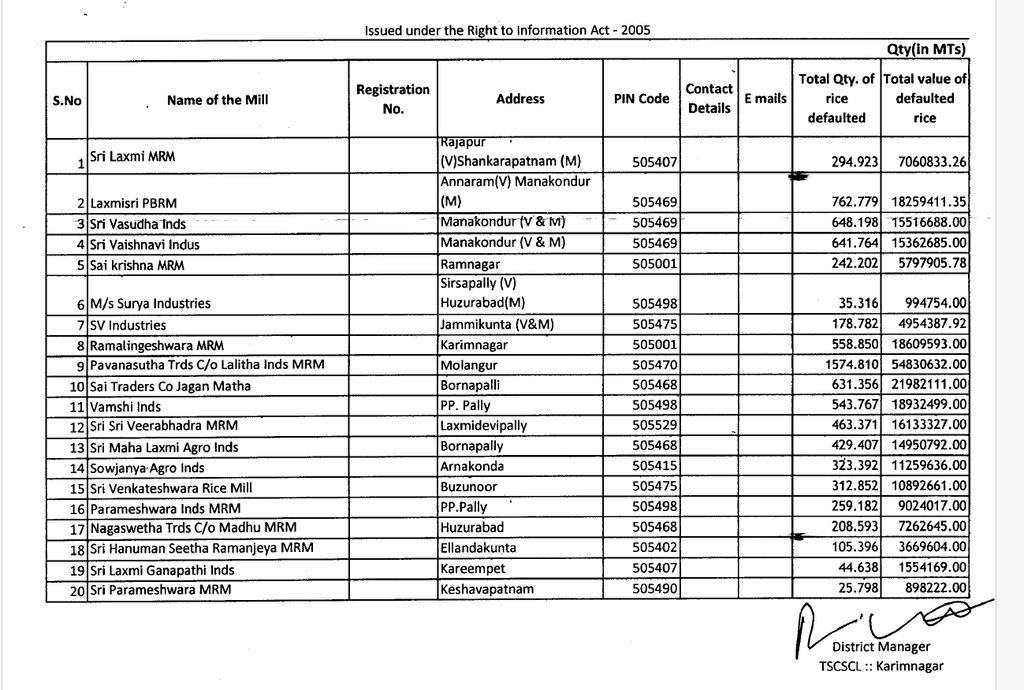
District-Wise Details: CMR Defaulters
| S.No. | Rice Mill / Trader | Location | Defaulted Rice (MT) | Defaulted Value |
| 1 | Pavanasutha Trds C/o Lalitha Inds MRM | Molangur | 1,574.810 | ₹5,48,30,632.00 |
| 2 | Sai Traders C/o Jagan Matha | Bornapalli | 631.356 | ₹2,19,82,111.00 |
| 3 | Vamshi Inds | PP. Pally | 543.767 | ₹1,89,32,499.00 |
| 4 | Ramalingeshwara MRM | Karimnagar | 558.850 | ₹1,86,09,593.00 |
| 5 | Laxmisri PBRM | Annaram, Manakondur | 762.779 | ₹1,82,59,411.35 |
| 6 | Sri Sri Veerabhadra MRM | Laxmidevipally | 463.371 | ₹1,61,33,327.00 |
| 7 | Sri Vasudha Inds | Manakondur | 648.198 | ₹1,55,16,688.00 |
| 8 | Sri Vaishnavi Indus | Manakondur | 641.764 | ₹1,53,62,685.00 |
| 9 | Sri Maha Laxmi Agro Inds | Bornapally | 429.407 | ₹1,49,50,792.00 |
| 10 | Sowjanya Agro Inds | Arnakonda | 323.392 | ₹1,12,59,636.00 |
| 11 | Sri Venkateshwara Rice Mill | Buzunoor | 312.852 | ₹1,08,92,661.00 |
| 12 | Parameshwara Inds MRM | PP. Pally | 259.182 | ₹90,24,017.00 |
| 13 | Nagaswetha Trds C/o Madhu MRM | Huzurabad | 208.593 | ₹72,62,645.00 |
| 14 | Sri Laxmi MRM | Rajapur, Shankarapatnam | 294.923 | ₹70,60,833.26 |
| 15 | Sai Krishna MRM | Ramnagar | 242.202 | ₹57,97,905.78 |
| 16 | SV Industries | Jammikunta | 178.782 | ₹49,54,387.92 |
| 17 | Sri Hanuman Seetha Ramanjeya MRM | Ellandakunta | 105.396 | ₹36,69,604.00 |
| 18 | Sri Laxmi Ganapathi Inds | Kareempet | 44.638 | ₹15,54,169.00 |
| 19 | M/s Surya Industries | Sirsapally, Huzurabad | 35.316 | ₹9,94,754.00 |
| 20 | Sri Parameshwara MRM | Keshavapatnam | 25.798 | ₹8,98,222.00 |
Note: The above table reproduces the individual entries supplied in the RTI response. The district-level total reported by the authorities is 9,981.284 MTs valued at ₹30,94,80,634.31.
What Does CMR Mean?
Under the Custom Milled Rice (CMR) system, paddy procured through government agencies is entrusted to rice mills for milling. The resultant rice is required to be delivered to the government procurement/distribution system as per the applicable terms and prescribed obligations.
When rice remains outstanding or a mill fails to meet its delivery obligations, questions arise regarding recovery, accountability, monitoring and possible financial loss to the public exchequer.
The Karimnagar RTI disclosure therefore raises important public-interest questions:
- How much paddy was originally allotted to each mill?
- What quantity of CMR was required to be delivered?
- How much rice was actually delivered?
- What caused the outstanding/default quantities?
- How much money has already been recovered?
- What recovery proceedings have been initiated?
- Were criminal cases registered wherever warranted?
- What action was taken against responsible officials?
- How long have these outstanding quantities remained unrecovered?
Citizens Using RTI to Protect Public Resources
The disclosure also demonstrates the role of citizens in monitoring public administration.
By seeking records relating to government grain, procurement, milling and recovery, citizens can examine whether public resources are being properly safeguarded.
Article 51A of the Constitution of India sets out Fundamental Duties of citizens. Citizen participation in public accountability, including the lawful use of the RTI Act, can contribute to greater transparency and responsible administration.
Sri Ganji Srinivasa Rao’s RTI application demonstrates how information held by government authorities can be brought into the public domain and examined by citizens, journalists and civil-society organisations.
Karimnagar: A Localised Window Into a Larger CMR Issue
The Karimnagar figures assume significance in the context of wider scrutiny of CMR operations in Telangana.
State-level figures cited in connection with alleged CMR irregularities have put the broader issue at approximately ₹13,399 crore, involving nearly 59.96 lakh tonnes of rice since 2014.
The state government has undertaken scrutiny of paddy procurement and custom milling operations covering previous years to identify shortages, defaults and responsibility.
Recovery and enforcement measures against defaulting millers have also been reported.
However, statewide figures need to be examined against district-wise and mill-wise official records. The Karimnagar RTI disclosure provides one such localised dataset and demonstrates the value of obtaining primary government records.
The Bigger Question: Where Did the Rice Go?
The most important issue arising from the RTI disclosure is not merely the identification of defaulting entities.
The public deserves to know:
Was the defaulted rice ultimately recovered?
If not, what is the present status of recovery?
Who was responsible for monitoring the government stock?
Was any government loss caused, and if so, has the entire amount been recovered?
Were departmental, civil or criminal proceedings initiated wherever required?
These questions can be answered only through further examination of official records.
RTI Turns Information Into Accountability
The Karimnagar CMR disclosure is another example of how the Right to Information Act, 2005 can empower citizens to examine the management of public resources.
An RTI application may begin with a simple request for information, but the records obtained can help uncover patterns, identify accountability gaps and encourage further administrative scrutiny.
For Way2RTI.com, the Karimnagar disclosure reinforces a simple principle:
Public Money. Public Resources. Public Accountability.
When citizens ask questions and obtain official records, government information can become a powerful instrument for transparency and accountability.