RTI Exposes Investment Mystery: Announcements and MoUs, Not Actual Investments
Telangana Investment Claims vs RTI Reality
Government Said ₹2.45 Lakh Crore, RTI Reply Lists ₹2.71 Lakh Crore Commitments
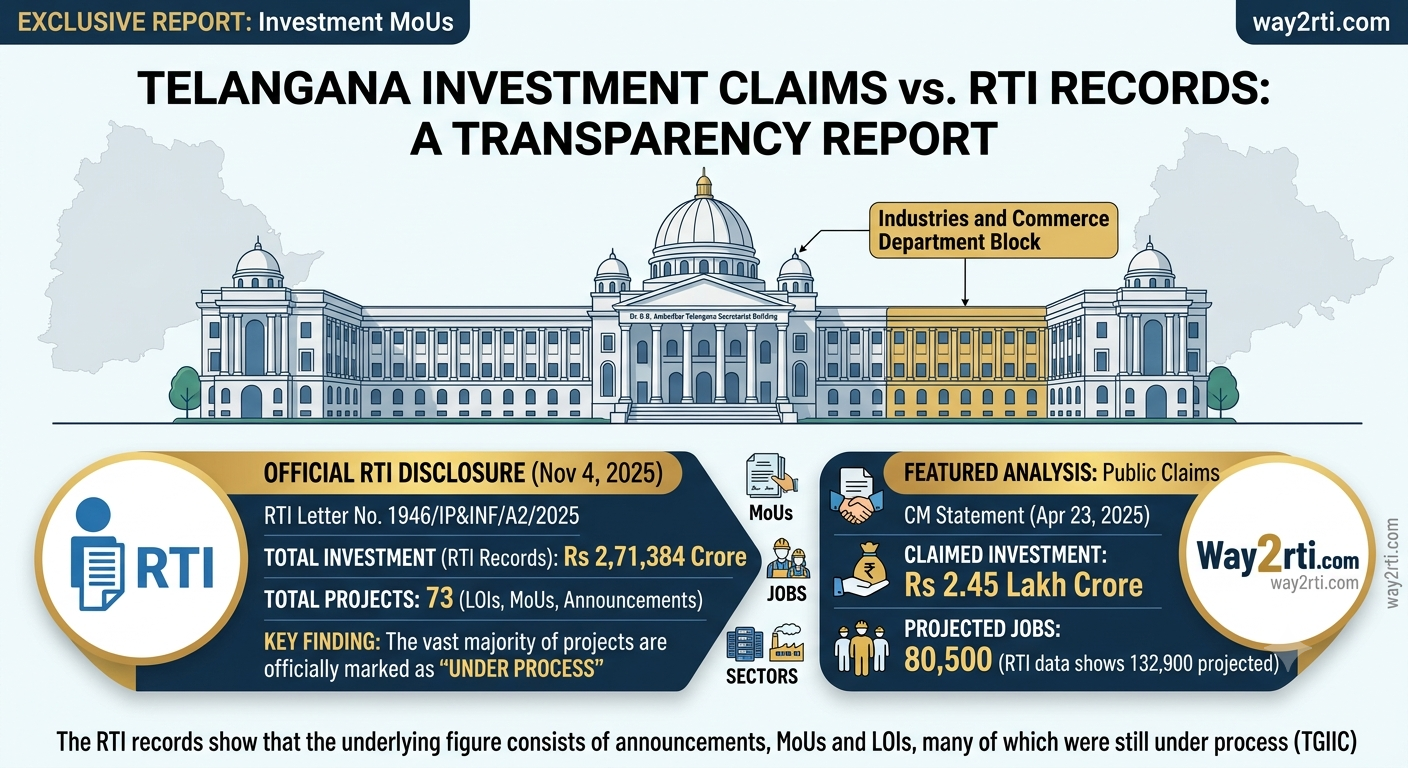
Government’s ₹2.45 lakh crore investment claim faces questions after RTI reveals 73 announcements, MoUs and LOIs worth ₹2.71 lakh crore
Hyderabad: The Telangana government’s much-publicised claim of securing ₹2.45 lakh crore in investments and 80,500 jobs in 16 months has come under scrutiny after information obtained under the Right to Information Act, 2005, revealed a different picture of the investment commitments announced during the Chief Minister’s international visits.
A report published by Deccan Chronicle on 23 April 2025, quoting official sources in the Chief Minister’s Office, stated that the Congress government led by Chief Minister A. Revanth Reddy had secured investments worth ₹2,44,962 crore through international engagements since December 2023, with the investments expected to generate approximately 80,500 jobs.
However, an RTI response furnished by the Industries and Commerce (IP&INF) Department, Government of Telangana, provides a cumulative list of 73 announcements, Memoranda of Understanding (MoUs) and Letters of Intent (LOIs) involving investment commitments of ₹2,71,384 crore.
The difference raises an important public-accountability question:
Were the figures announced to the public based on actual investments and projects, or were they largely based on announcements, MoUs and LOIs that were still at various stages of processing?
What the Government publicly claimed
According to the Deccan Chronicle report dated 23 April 2025, Telangana had attracted:
- ₹2.45 lakh crore in investments;
- Approximately 80,500 jobs;
- ₹12,062 crore from the April 2025 Japan visit;
- ₹1.78 lakh crore at the January 2025 World Economic Forum (WEF) in Davos;
- ₹14,900 crore from visits to the USA, South Korea and Singapore;
- Earlier, ₹40,232 crore in MoUs at the January 2024 Davos summit.
The report further stated that officials had briefed the Chief Minister that 18 projects connected with the Davos agreements had been taken up, with 17 already underway and 10 progressing rapidly.
These figures created an impression of substantial investment inflows and large-scale employment generation in Telangana.
What the RTI information reveals
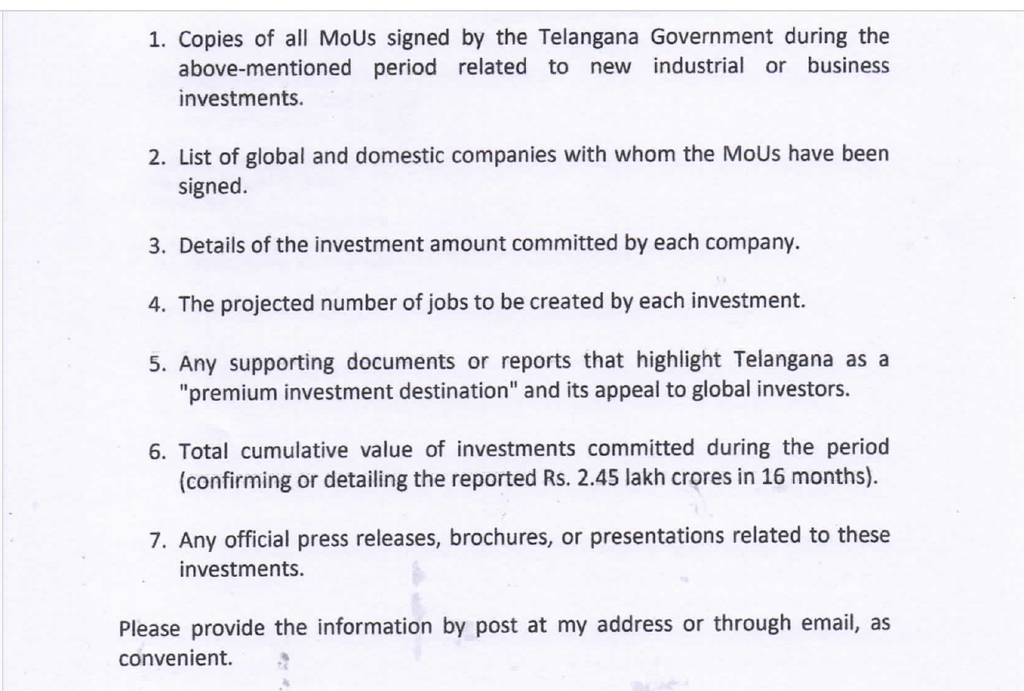
An RTI application was filed by RTI activist Ganji Srinivasa Rao before the Principal Secretary, Industries and Commerce Department, Hyderabad, on 25 April 2025, seeking information relating to the investment announcements/MoUs/LOIs.
When the information was not furnished within the statutory 30-day period, Rao filed a first appeal on 27 May 2025.
The Public Information Officer subsequently issued a reply under the RTI Act. The information furnished by the Industries and Commerce Department provides a consolidated picture of the announcements and commitments made during international visits.
According to the RTI information, the department recorded:
73 announcements/MoUs/LOIs
₹2,71,384 crore in investment commitments
The RTI data covers international engagements from the 2024 Davos visit through the April 2025 Japan visit.
RTI-reported investment commitments
| International visit | Announcements / MoUs / LOIs | Amount |
| WEF Davos – January 2024 | 18 | ₹40,232 crore |
| USA & South Korea – August 2024 | 24 | ₹36,100 crore |
| Singapore – January 2025 | 2 | ₹3,950 crore |
| WEF Davos – January 2025 | 26 | ₹1,78,950 crore |
| Japan – April 2025 | 3 | ₹12,152 crore |
| Total | 73 | ₹2,71,384 crore |
The crucial distinction: investment versus commitment
The most significant finding from the RTI response is the terminology.
The department’s information refers to announcements, MoUs and LOIs and their corresponding investment commitments.
That is materially different from saying that the entire amount had already entered Telangana as actual investment.
In several cases, the RTI information itself records the status as “Under process”, while some projects involve land allotments, proposed expansions, proposed facilities or other stages of implementation.
Therefore, a commitment of ₹10,000 crore, ₹45,500 crore or ₹60,000 crore cannot automatically be treated as the same thing as ₹10,000 crore, ₹45,500 crore or ₹60,000 crore actually invested.
Japan visit: Government statement versus RTI record
The difference is particularly visible in the Japan figures.
The Deccan Chronicle report stated that the Japan visit resulted in MoUs worth approximately ₹12,062 crore, projected to create about 30,500 jobs.
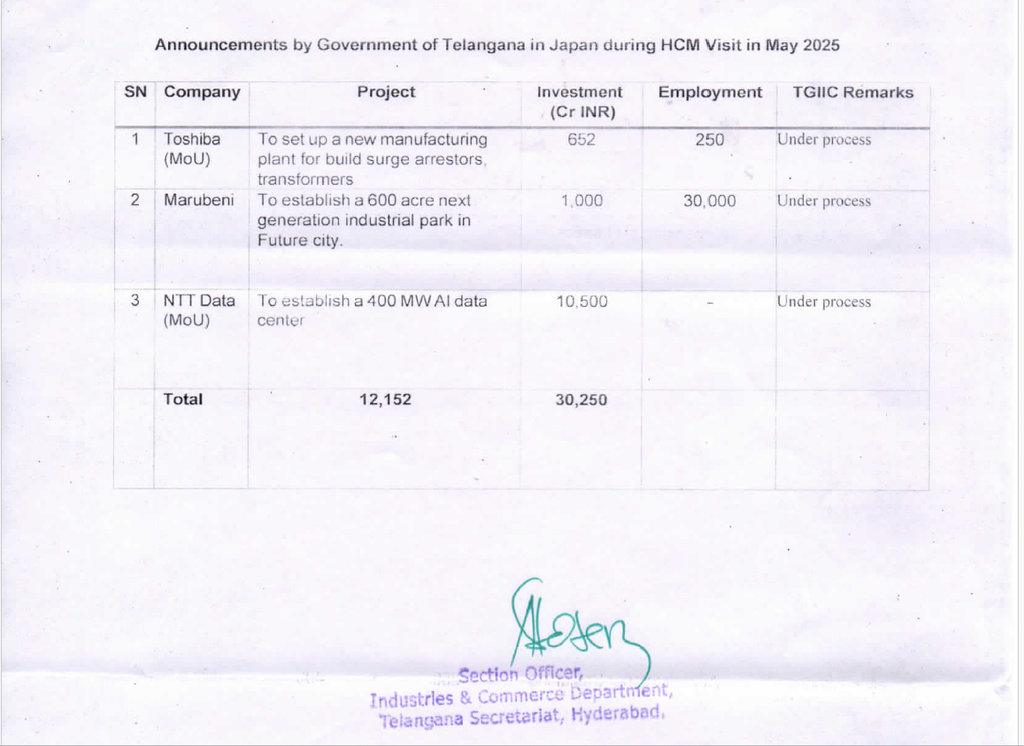
The RTI response, however, records:
- 3 projects
- ₹12,152 crore
- 30,250 jobs
The RTI details identify:
Toshiba — Manufacturing plant for surge arrestors and transformers
Investment: ₹652 crore
Jobs: 250
Status: Under process
Marubeni — Next-generation industrial park
Investment: ₹1,000 crore
Jobs: 30,000
Status: Under process
NTT Data — 400 MW AI Data Centre
Investment: ₹10,500 crore
Status: Under process
Thus, the RTI record itself shows that the listed projects were not necessarily completed investments; they were commitments at different stages of processing.
January 2025 Davos: ₹1.78 lakh crore claim
The government’s public communication highlighted ₹1.78 lakh crore attracted at the January 2025 WEF Davos event.
The RTI response records 26 projects/announcements involving ₹1,78,950 crore.
But the detailed information shows that several of the major proposals were still “Under process.”
Among them were:
- Amazon Web Services: ₹60,000 crore data-centre expansion;
- Tillman Global Holdings: ₹15,000 crore data centre;
- CtrlS: ₹10,000 crore data centre;
- Sify Technologies: ₹10,000 crore data centre and AI hubs;
- Sun Petrochemicals: ₹45,500 crore energy projects;
- Mytrah Energy: ₹7,000 crore solar-cell and module unit;
- Megha Engineering: ₹15,250 crore;
- Ramky Group: ₹5,000 crore.
The RTI response therefore provides an important qualification to the headline investment figure: a substantial portion represented proposed investments and commitments rather than completed investments.
2024 Davos: 18 projects and ₹40,232 crore
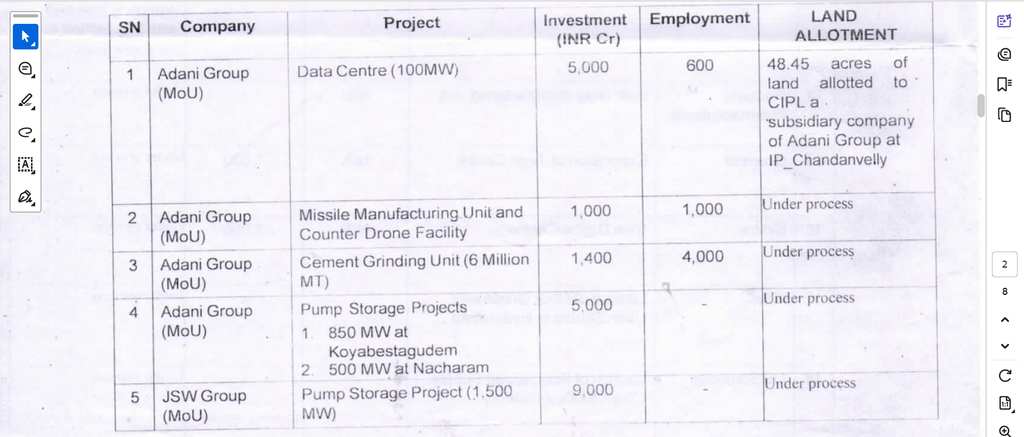
For the January 2024 WEF Davos visit, the RTI response records 18 projects involving ₹40,232 crore.
The list includes major proposals from the Adani Group, JSW Group, Webwerks/Iron Mountain, Godrej, Tata Technologies, Godi Energy, Aragen Life Sciences and others.
But again, several project entries carry the status “Under process.”
For example:
- Adani Data Centre — ₹5,000 crore;
- JSW Pump Storage Project — ₹9,000 crore;
- Webwerks Data Centre — ₹5,200 crore;
- Godi Energy — ₹8,000 crore;
- BL Agro — ₹500 crore.
The RTI information therefore makes it necessary to distinguish between an announced investment, an investment commitment, an investment under process, and an investment actually realized on the ground.
USA and South Korea: 24 projects, ₹36,100 crore
The RTI response records 24 projects worth ₹36,100 crore from the August 2024 USA and South Korea visit, with a projected employment figure of 34,550 jobs.
Several entries relate to proposed GCCs, R&D centres, data centres, manufacturing and other expansions, with land or project setup described as being under process.
This raises another question:
How many of these projects have actually commenced commercial operations?
The RTI information, as furnished, does not establish that the entire ₹36,100 crore has already been invested.
Singapore: ₹3,950 crore
For the January 2025 Singapore visit, the RTI response records:
- ST Telemedia: ₹3,500 crore;
- CapitaLand: ₹450 crore;
- Total: ₹3,950 crore.
Both projects are described as under process.
RTI journey itself raises accountability questions
The RTI application was filed on 25 April 2025, shortly after the government’s international investment claims were publicly reported.
The applicant states that information was not furnished within the prescribed 30-day period.
A first appeal was filed on 27 May 2025.
The subsequent PIO reply, according to the documents provided by the applicant, invoked Section 8(1)(d) of the RTI Act, 2005, claiming exemption relating to commercial confidence and related information.
The First Appellate Authority subsequently issued a communication stating that the PIO’s position “holds good.”
The applicant then approached the Telangana Information Commission under Section 19(3) of the RTI Act.
The Commission proceedings ultimately resulted in directions concerning furnishing available information and also action against a deemed Public Information Officer in relation to non-furnishing of information and non-attendance at a hearing.
This episode itself raises a fundamental question:
If the State is publicly highlighting investment figures as a major achievement, why should citizens face prolonged resistance in obtaining the underlying official records through the RTI Act?
₹2.45 lakh crore versus ₹2.71 lakh crore — what explains the difference?
The publicly reported government figure was approximately ₹2,44,962 crore, whereas the RTI response lists ₹2,71,384 crore.
That is a difference of approximately ₹26,422 crore.
The difference may arise from differences in the period covered, classification of announcements, subsequent revisions, inclusion/exclusion of particular commitments, or the methodology used to compile the figures.
But that itself is a matter requiring clarification.
The government should disclose:
- How was the ₹2,44,962 crore figure calculated?
- Why does the RTI response show ₹2,71,384 crore?
- Which projects are included in one figure but excluded from the other?
- How much of the announced amount has actually been invested?
- How many of the announced projects have commenced commercial operations?
- How many jobs have actually been created against the claimed 80,500 jobs?
- How many MoUs/LOIs have expired, been cancelled or remained unimplemented?
- How much government land has been allotted to these projects?
- What incentives, subsidies, concessions and other benefits have been extended?
- What is the project-wise implementation status as of 2026?
The real measure is not MoUs — it is implementation
MoUs and LOIs can indicate investor interest, but they are not by themselves proof of actual capital expenditure, production, employment or operational projects.
For public accountability, the more meaningful indicators are:
Investment announced → land allotted → approvals obtained → construction started → capital invested → plant commissioned → jobs actually created.
Until these stages are independently established, describing the entire announced amount as “investment secured” can create a misleading impression about actual investment inflows.
Way2RTI.com’s key finding
The RTI response does not necessarily contradict every figure reported in the media. Rather, it adds an important layer of official detail that was missing from the headline claim.
The Government highlighted the cumulative investment achievement.
The RTI records show that the underlying figure consists of announcements, MoUs and LOIs, many of which were still under process.
That distinction is critical.
Headline claims may count commitments. Public accountability must count implementation.
The Telangana government now has an opportunity to remove the ambiguity by publishing a project-wise dashboard showing the status of every investment announcement, the amount actually invested, land allotted, jobs actually created and present stage of implementation.
That would allow citizens to determine how much of the promised ₹2.71 lakh crore has truly become investment on the ground.
Way2RTI.com will continue to track the implementation of these investment commitments through the Right to Information Act, 2005.
Important document/date note
The RTI material supplied for this story contains some letter-number/date inconsistencies that should be checked against the original certified copies before publication. In particular, the references to Letter Nos. 1855, 1946 and 1956/IP&INF/A2/2025, and the Telangana Information Commission decision date stated as 31-01-2025 despite references to hearings on 23-09-2025 and 30-10-2025, appear internally inconsistent. The final published version should reproduce the dates and numbers exactly as they appear on the certified documents.