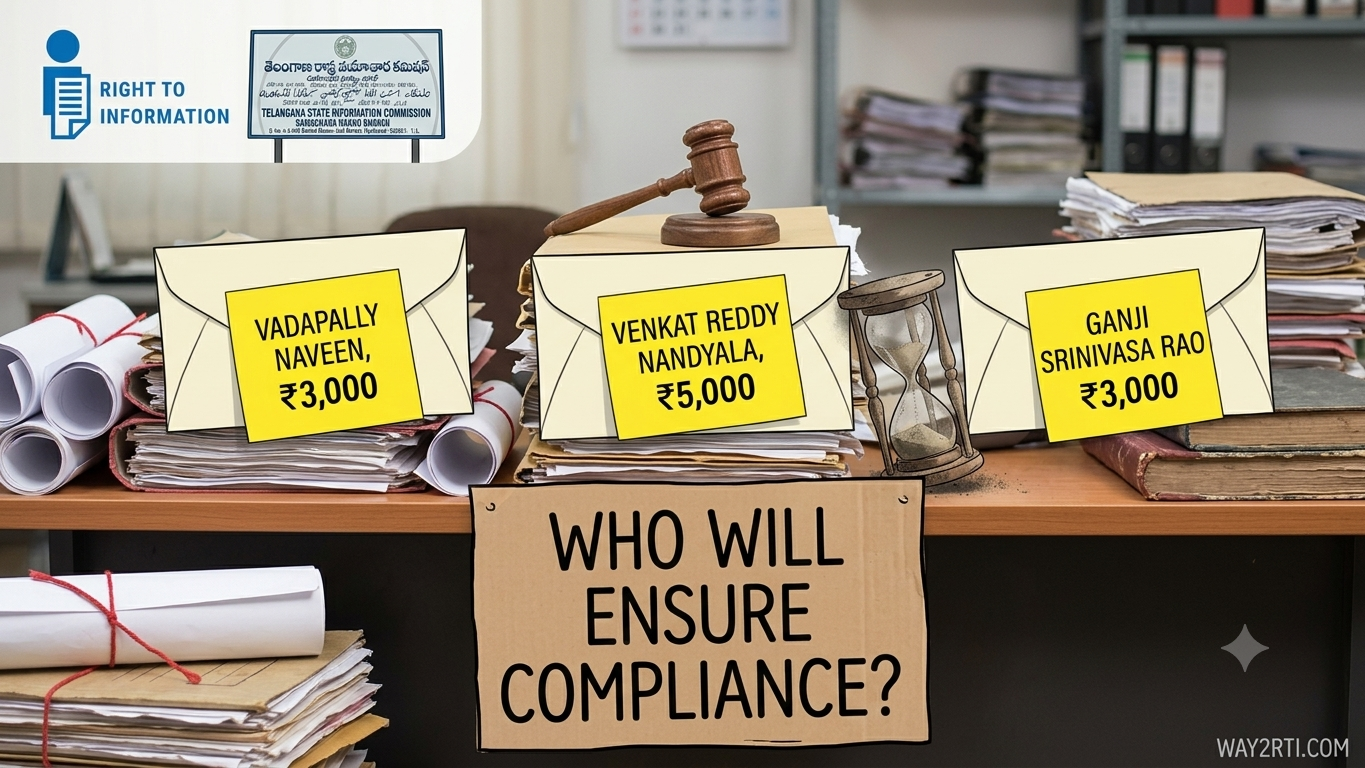
Telangana Information Commission Orders ₹11,000 Compensation in Three RTI Cases: Who Will Ensure Compliance?
Narketpally MPDO cases raise questions over compensation payments, PIO accountability, show-cause notices and delayed publication of Commission orders
Telangana: The Telangana Information Commission has reportedly ordered a total of ₹11,000 in compensation in three RTI proceedings involving the Mandal Parishad Development Officer (MPDO), Narketpally Mandal, Nalgonda district. The cases raise important questions about the implementation of Commission orders, accountability of Public Information Officers (PIOs), and timely access to official decisions.
The proceedings concern alleged failures to provide information under the Right to Information (RTI) Act, 2005, non-compliance with earlier directions and repeated absence of a PIO from hearings. In one case, RTI Consultant and Social Activist Ganji Srinivasa Rao also reported difficulty obtaining the order after the hearing on September 21, 2026.
The key question is whether the information has been furnished, the compensation has actually been paid and the Commission’s directions have been implemented.
Three cases, ₹11,000 in compensation
1. Vadapally Naveen: ₹3,000 compensation
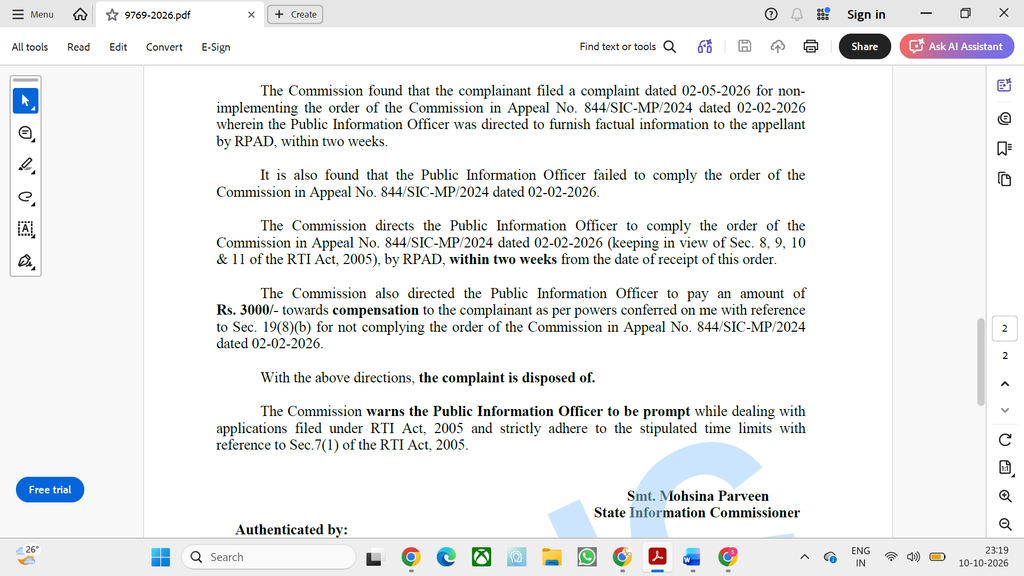
In Complaint No. 9769/SIC-MP/2026, Vadapally Naveen of Nalgonda district complained that the PIO had failed to comply with an earlier Commission order dated February 2, 2026, in Appeal No. 844/SIC-MP/2024. The earlier order directed the PIO to furnish factual information through Registered Post Acknowledgement Due (RPAD) within two weeks.
At the hearing on July 27, 2026, notice was reportedly sent to Kattangur Mandal instead of Narketpally Mandal, and both respondents were absent. At the adjourned hearing on August 24, 2026, the complainant was represented through an affidavit, while the PIO and First Appellate Authority remained absent.
The Commission directed the PIO to furnish the information within two weeks of receiving the order, subject to applicable provisions of Sections 8, 9, 10 and 11 of the RTI Act. It also ordered ₹3,000 compensation under Section 19(8)(b) and warned the PIO to observe the statutory timelines under Section 7(1).
2. Venkat Reddy Nandyala: ₹5,000 compensation
In Appeal No. 14378/SIC-PVSR/2026, Venkat Reddy Nandyala sought information concerning Dasorigudem Gram Panchayat through an RTI application dated February 3, 2026. The request covered development works, expenditure, Measurement Books, bills, vouchers, muster rolls, audit reports, contractor details and Gram Sabha records for the period beginning February 2, 2024.
According to the case details, the PIO did not furnish the information, and the First Appellate Authority did not dispose of the first appeal filed on March 3, 2026.
The PIO reportedly missed hearings on August 17 and September 21, 2026. In its order dated September 21, the Commission directed the PIO to furnish the requested information through RPAD within 15 days. It also ordered the public authority/MPDO, Narketpally, to pay ₹5,000 compensation within one month and directed the issuance of a show-cause notice to the PIO, as previously decided on August 17.
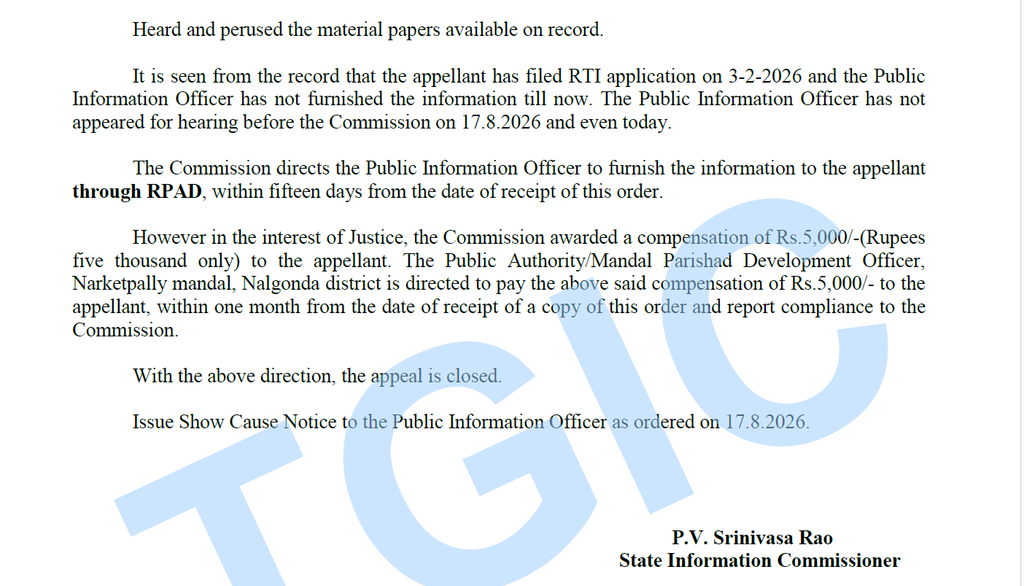
These records concern public expenditure and village development works. Their disclosure enables citizens to scrutinise the use of public funds and verify whether sanctioned works were carried out.
3. Ganji Srinivasa Rao: ₹3,000 compensation and delayed order publication
In Complaint No. 5286 (the exact number and year should be verified against the certified order), RTI Consultant and Social Activist G. Srinivasa Rao sought certified records from the MPDO, Narketpally, through an RTI application dated May 9, 2025.
The application sought rules and guidelines defining the MPDO’s functions, records relating to a complaint dated April 23, 2025, Action Taken Reports, correspondence with Cheruvugattu Gram Panchayat, and relevant inward-register entries, file numbers and note files.
According to Rao, the PIO did not provide the requested information. He approached the Commission under Section 18(1) of the RTI Act.
At the hearing on September 21, 2026, Rao was present, while the PIO was absent. The order reportedly recorded the PIO’s absence on July 1, August 12 and September 21, 2026. Rao also states that his attendance and the hearing conducted on April 2, 2026, were not mentioned in the order; this discrepancy requires verification against the official hearing record.
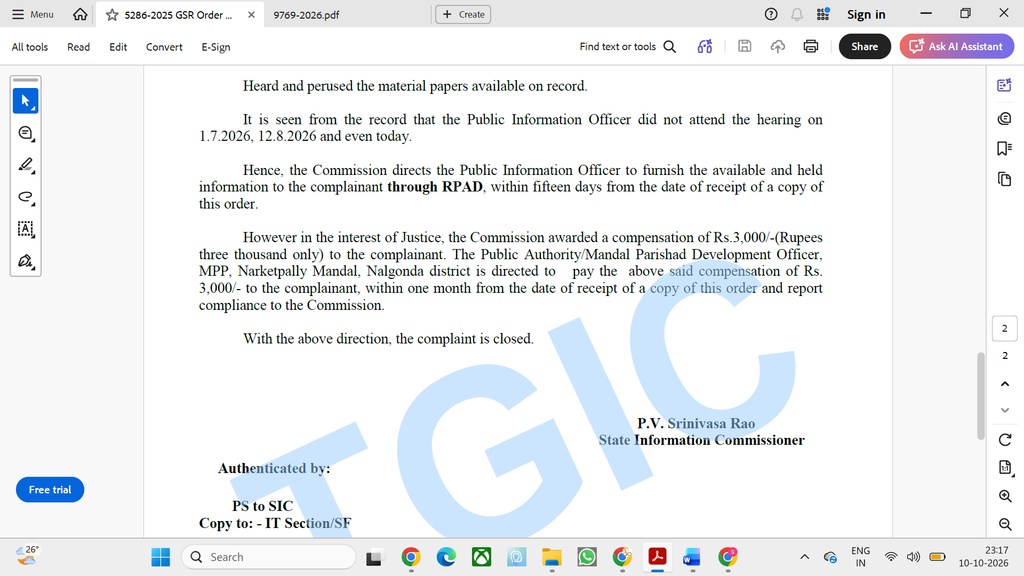
The Commission directed the PIO to furnish the available information through RPAD within 15 days and ordered ₹3,000 compensation within one month.
Order not initially available online
Rao states that after the September 21 hearing, he had not received a copy of the order and could not find it on the Commission’s official website.
On October 7, 2026, he telephoned the peshi (office staff) of State Information Commissioner P.V. Srinivasa Rao to enquire about the order. According to Rao, the staff informed him that it would take another 15 days.
Rao raised the issue on X (formerly Twitter) on the same day. On October 9, 2026, he checked the official website again and found that the order had been uploaded.
The sequence raises questions about timely access to Commission orders. Although the order was subsequently available online, the precise dates of its finalisation and formal issue require verification.
Who will ensure compensation is actually paid?
The three orders reportedly direct compensation totalling ₹11,000: ₹3,000 to Naveen, ₹5,000 to Nandyala and ₹3,000 to Rao. These are amounts ordered, not confirmed payments.
Applicants who have not received compensation can submit a written representation to the concerned public authority, enclosing the Commission’s order and requesting payment. They can seek existing payment records, including sanction proceedings, bills, vouchers and payment references, and notify the Commission if the deadline has expired without payment.
The Commission should be asked to verify compliance with its directions and take appropriate action within its statutory powers.
Under Section 19(8)(b), the Commission may require a public authority to compensate a complainant for loss or other detriment suffered. Section 20 separately provides for penalties against PIOs where statutory conditions are met, including unreasonable delay without reasonable cause or other specified violations. The penalty can be ₹250 per day, up to ₹25,000, following the procedure prescribed by law.
A show-cause notice is not itself a penalty. The PIO must have an opportunity to explain, and any final decision must follow the Act.
Questions over transparency and enforcement
The three proceedings raise several questions for the Telangana Information Commission:
- Have the PIOs supplied the information directed to be disclosed?
- Have all three compensation amounts actually been paid?
- In Nandyala’s case, was the show-cause notice issued and served, and what was the outcome?
- Why was notice reportedly sent to Kattangur instead of Narketpally in Naveen’s case?
- Will the Commission verify Rao’s concern about the April 2 hearing record?
- Why was Rao reportedly told on October 7 that he would have to wait another 15 days when he found the order online on October 9?
- Will the Commission publish case-wise updates on order dates, upload dates, compensation payments and show-cause proceedings?
The absence of a show-cause notice from the website does not establish that it was never issued, and the RTI Act does not automatically require every individual notice to be published online. Nevertheless, timely publication of orders and appropriate case-status information would help applicants track proceedings and improve public accountability.
Conclusion: Orders must translate into action
The effectiveness of the RTI Act depends not merely on the issuance of orders but on their implementation. Information must reach applicants, compensation must be paid when ordered, and show-cause proceedings must be completed in accordance with law.
The Telangana Information Commission should consider strengthening its case-wise compliance monitoring and ensuring timely access to orders. Citizens should be able to determine whether information was furnished, compensation was paid and proceedings were concluded without repeated follow-ups.
The central question is simple: When the Information Commission orders information to be supplied and compensation to be paid, who verifies that its directions have actually been implemented?
Editorial note: Verify the case identifiers and operative directions against certified orders. The ₹11,000 total represents compensation reportedly ordered, not independently verified payments. Rao’s account of the telephone conversation and the order-upload timeline should be attributed to him unless independently documented.
WAY2RTI.COM — Know Your Right. Obtain Information. Resolve Your Problem.
Contact : gsrao@way2rti.com