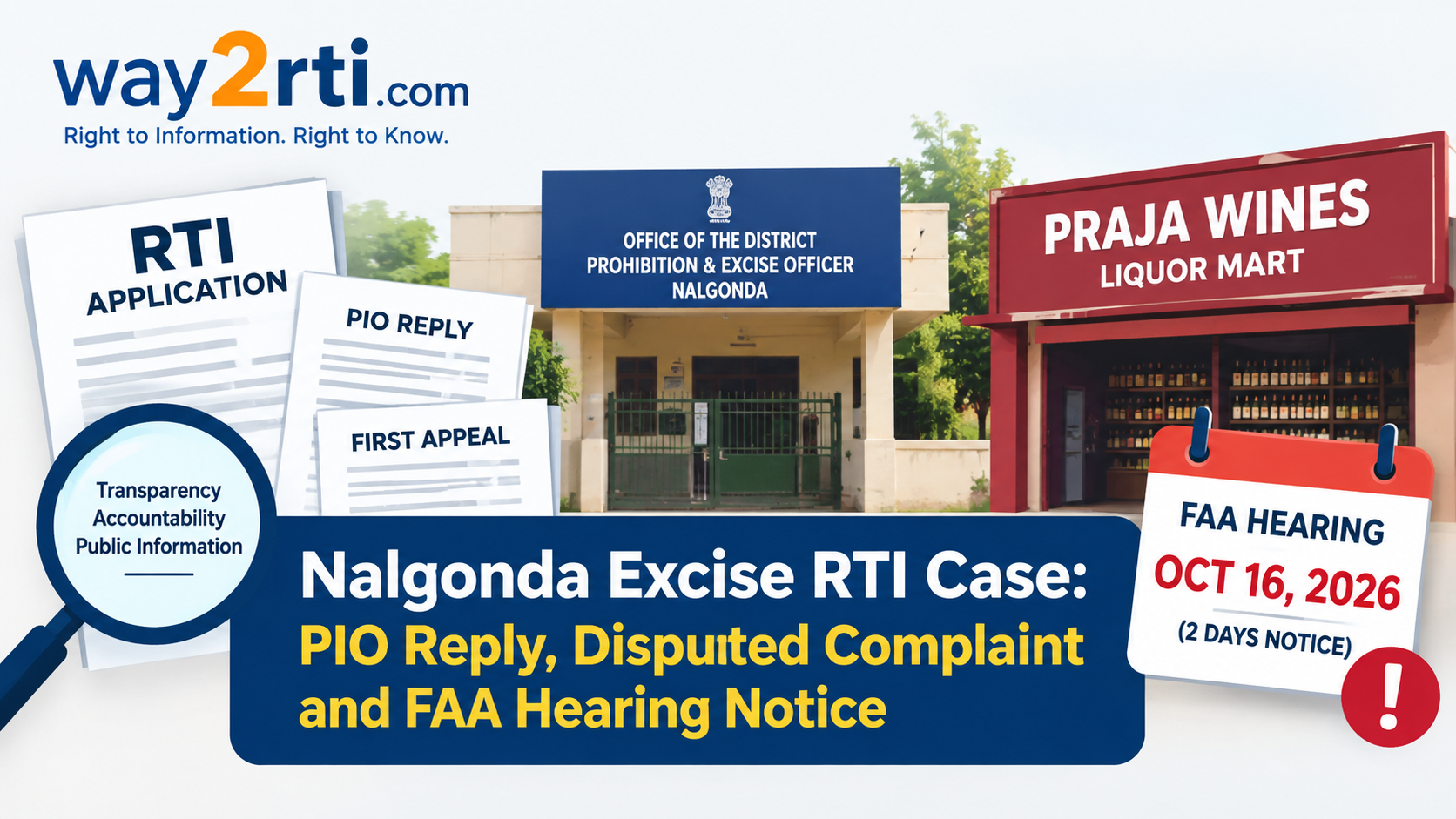
Advocate N. Venkat Reddy challenges PIO’s reply on Praja Wines; FAA’s short notice and warning of closure raise concerns over natural justice and fair appellate procedure
NALGONDA, TELANGANA: Allegations of incomplete information, a disputed complaint acknowledgment and an extremely short hearing notice have raised questions about transparency and procedural fairness in the Nalgonda Prohibition and Excise Department.
N. Venkat Reddy, an advocate residing at Dasarigudem village in Narketpally mandal, Nalgonda district, has challenged the response furnished by the Public Information Officer (PIO) concerning M/s Praja Wines Liquor Mart, Nalgonda. The dispute has now reached the First Appellate Authority (FAA), whose hearing notice dated October 12, 2026, was reportedly received by the applicant on October 14, just two days before the scheduled hearing on October 16.
The case raises questions about the completeness of information supplied under the Right to Information (RTI) Act, 2005, the verification of a complaint allegedly received by the department, and whether an appellant was afforded a reasonable opportunity to prepare for an appeal hearing.
August 11, 2026: RTI application filed
N. Venkat Reddy filed an RTI application under Section 6(1) of the RTI Act on August 11, 2026. The application was officially received and stamped on the same day by the Office of the District Prohibition and Excise Officer, Nalgonda.
The application sought 13 categories of information relating to M/s Praja Wines, including:
- A certified copy of the current A4 licence and its conditions.
- Applicable Excise Rules, government orders, circulars and departmental instructions.
- Rules governing additional charges for UPI, debit card and credit card payments.
- Mandatory issuance of sales bills and computer-generated invoices.
- Requirements for displaying the licence, licence number, MRP list and statutory notices.
- Applicable penalties for overcharging, failure to issue bills and other licence violations.
- Inspection reports, complaints, show-cause notices and penalties from January 1, 2025, onward.
- Names and designations of the officers responsible for inspecting the shop.
- Inspection checklists, standard operating procedures and inspection powers.
- Rules governing the retention of registers, invoices, digital payment records and CCTV footage.
- Procedures for handling complaints about excess pricing and licence violations.
- The status and action taken on a complaint allegedly submitted by the applicant.
The application sought documentary information to establish how the department regulates licensed liquor shops and responds to alleged violations.
August 14, 2026: Applicant says complaint was received
A central issue in the dispute concerns a complaint about an incident allegedly occurring at Praja Wines on August 1, 2026.
Venkat Reddy maintains that he submitted the complaint and that it was received by the department on August 14, 2026. He says the copy bears the office’s inward stamp and has relied on it in challenging the PIO’s subsequent response.
The existence and significance of the acknowledgment are important because they may help establish whether the department received the complaint and whether the relevant records were properly checked before the RTI response was issued.
September 11, 2026: PIO furnishes reply
The Office of the District Prohibition and Excise Officer, Nalgonda, issued its reply on September 11, 2026, under reference number 1069/2026/D.
The PIO enclosed a certified copy of the A4 licence for M/s Praja Wines Liquor Mart. The licence, numbered NLG 021/2025-27/A2, was issued on November 24, 2025, in the name of Sri Mandadi Krishna Reddy. Its validity period is December 1, 2025, to November 30, 2027.
What did the PIO state?
According to the reply, the department’s position on the principal regulatory issues was as follows:
Digital payment charges: The PIO stated that additional charges over MRP for debit card, credit card, UPI or other digital payment methods are prohibited.
Sales bills: The reply stated that liquor must be sold at or below MRP and that computer-generated bills are mandatory under the licence conditions.
Display requirements: The shop must prominently display its A4 licence, price list and prescribed notices.
Inspection powers: The PIO stated that Excise Officers may inspect stocks, registers, accounts, point-of-sale records, digital transactions and CCTV footage in accordance with applicable rules.
Inspection procedures: The department stated that inspections are conducted under the standard Excise Rules, but no separate standalone inspection checklist or SOP document was maintained.
Record retention: The PIO stated that no consolidated record specifying individual retention periods for invoices, registers, point-of-sale records, digital payment records and CCTV footage was available in the office.
Previous complaints and penalties: The department stated that no complaints, show-cause notices or penalty records against Praja Wines were available for the period beginning January 1, 2025.
Applicant’s complaint: The PIO stated that no complaint from Venkat Reddy against Praja Wines was found registered in the office records and, consequently, no action-taken record was available.
The applicant disputes the response concerning his complaint and argues that the department should have verified its own inward records and furnished the relevant documentary information.
September 17, 2026: First appeal filed
Dissatisfied with several parts of the PIO’s response, Venkat Reddy filed a first appeal under Section 19(1) of the RTI Act on September 17, 2026, before the First Appellate Authority in the Nalgonda Excise Department.
He accepted the A4 licence copy supplied by the PIO but challenged the responses to several other queries.
His principal objections were:
- Incomplete documentary information: The PIO allegedly provided general summaries instead of certified copies of the relevant government orders, circulars, statutory provisions and penalty provisions sought in the application.
- Disputed complaint acknowledgment: The applicant challenged the statement that no complaint had been registered, relying on the inward-stamped copy of the complaint he says was received on August 14.
- Absence of action-taken information: He sought verification of the complaint’s status and a report detailing any action taken.
- Inspection and regulatory records: He sought relevant documents concerning inspection procedures, officers’ powers and the rules governing the shop’s operations.
- Records relating to the incident: He requested relevant bills and tax invoices relating to August 1, 2026, subject to the availability of the records and applicable disclosure provisions.
The relief sought included directions to the PIO to furnish the requested certified documents, trace the complaint, disclose its status and provide relevant records concerning the incident.
October 12, 2026: FAA issues hearing notice
The FAA issued a hearing notice dated October 12, 2026, under reference number 1069/2026/D. It fixed the hearing for October 16, 2026, at 11:30 AM at the office of the District Prohibition and Excise Officer, Nalgonda.
The notice instructed Venkat Reddy to appear personally or through an authorised representative with his arguments, objections and supporting documents.
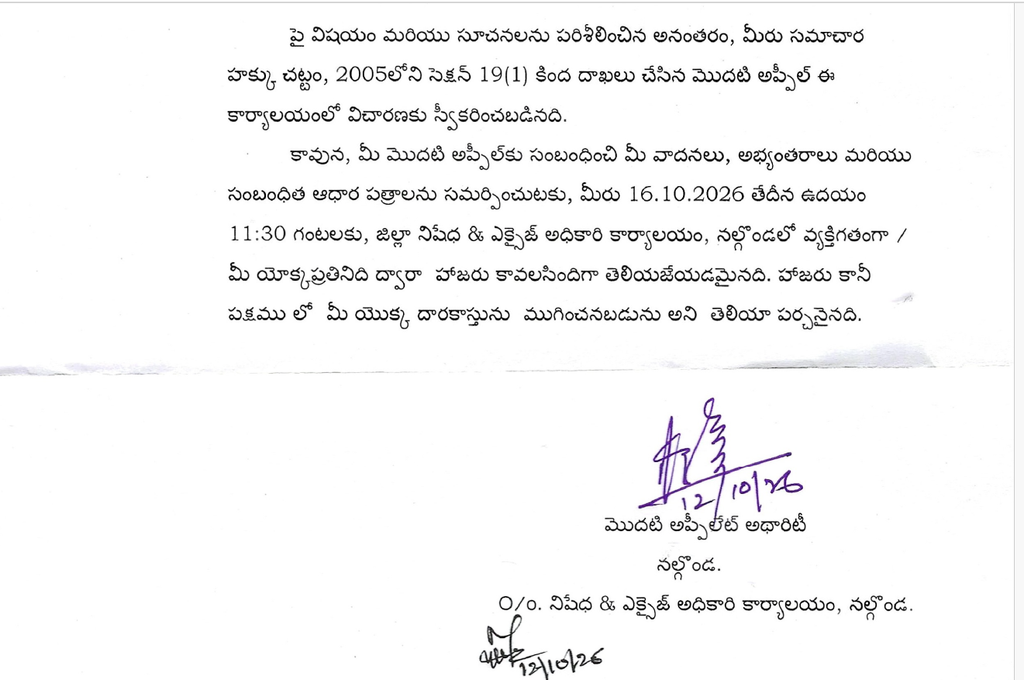
It also contained the following warning in substance: failure to attend would result in the appeal being closed on the basis of the available records.
October 14, 2026: Applicant receives notice, leaving two days
Venkat Reddy states that he received the notice only on October 14, although it was dated October 12. The hearing was scheduled for the morning of October 16, leaving approximately two days to prepare.
The short interval raises a question about whether the applicant was given a reasonable opportunity to organise his arguments, supporting documents and objections to the PIO’s reply.
The applicant contends that such a short notice period undermines the principles of natural justice. He also questions the warning that the appeal could be closed if he did not attend.
The RTI Act does not prescribe a universal 15-day minimum notice period for every first appeal hearing. Therefore, any claim that the FAA necessarily violated a mandatory 15-day requirement would need to be supported by the applicable Telangana rules, binding directions or other relevant legal authority.
Nevertheless, the practical question remains whether the notice and hearing arrangements in this particular case provided a fair and meaningful opportunity to participate.
Can the FAA close an appeal merely because the applicant does not attend?
The warning in the notice raises a separate procedural concern.
Section 19(1) of the RTI Act provides for a first appeal against a PIO’s decision or failure to decide. Section 19(5) places the burden of proving that a denial of information was justified on the PIO. Section 19(6) requires the first appeal to be disposed of within 30 days, extendable to 45 days for recorded reasons.
The Act does not expressly state that every appellant must personally attend a first appeal hearing. The FAA may need to hear the parties or seek clarifications under the applicable procedure, but the precise requirements must be assessed under the governing rules and directions.
The applicant’s objection is that the FAA should examine the written appeal, the documentary evidence and the PIO’s response rather than treat personal attendance as an absolute condition for consideration.
The distinction is important: a notice inviting an appellant to attend is not necessarily unlawful. However, whether an appeal can be closed solely because the appellant does not attend, without adequately considering the available record and applicable procedure, requires legal scrutiny.
The PIO’s attendance requirements must likewise be assessed under the applicable procedural rules; it would be inaccurate to assert that the RTI Act itself makes the PIO’s physical attendance mandatory at every first appeal hearing.
A reasoned order addressing the disputed points would help establish whether the applicant’s objections and supporting documents were properly considered.
Key questions the FAA should address
The first appeal presents several issues that require clear answers:
- Were the applicable rules, government orders, circulars and statutory provisions adequately disclosed in response to the RTI application?
- Was the department’s inward register checked to verify the applicant’s claim that his complaint was received on August 14, 2026?
- If the complaint was received, why did the PIO state that no complaint from the applicant was registered?
- What relevant records exist concerning the incident dated August 1, 2026?
- Was the short interval between receipt of the hearing notice and the hearing sufficient to provide a reasonable opportunity to participate?
- If the appellant could not attend, would his written submissions and documentary evidence still be considered before an order was passed?
The department’s records, the applicant’s acknowledgment and the FAA’s eventual order will be essential in resolving these questions.
Transparency and accountability must remain the priority
This case illustrates why access to public records is important in monitoring the administration of licensed businesses.
Where an applicant produces an acknowledgment that appears to conflict with an official response, the relevant public authority should verify the underlying records and explain the discrepancy. Similarly, appellate proceedings should follow the applicable law and provide a fair opportunity for the parties to present their positions.
The FAA has an opportunity to examine the disputed complaint, assess whether the PIO’s response was complete, consider the request for documentary information and issue a reasoned order under the RTI Act and applicable procedural rules.
The central issue is not merely whether an applicant attends a hearing. It is whether the statutory appeal provides an effective opportunity to question an incomplete or disputed RTI response and obtain a reasoned decision based on the available evidence.
Way2RTI.com will continue to highlight issues concerning transparency, access to information and accountability in the implementation of the RTI Act, 2005.
Contact: gsrao@way2rti.com