1.16 Lakh Telangana Government Orders Missing from Public Domain; High Court Petition Seeks Transparency
58.5% of G.Os. unavailable for public viewing, government figures reveal; questions raised over compliance with High Court directions under successive BRS and Congress governments
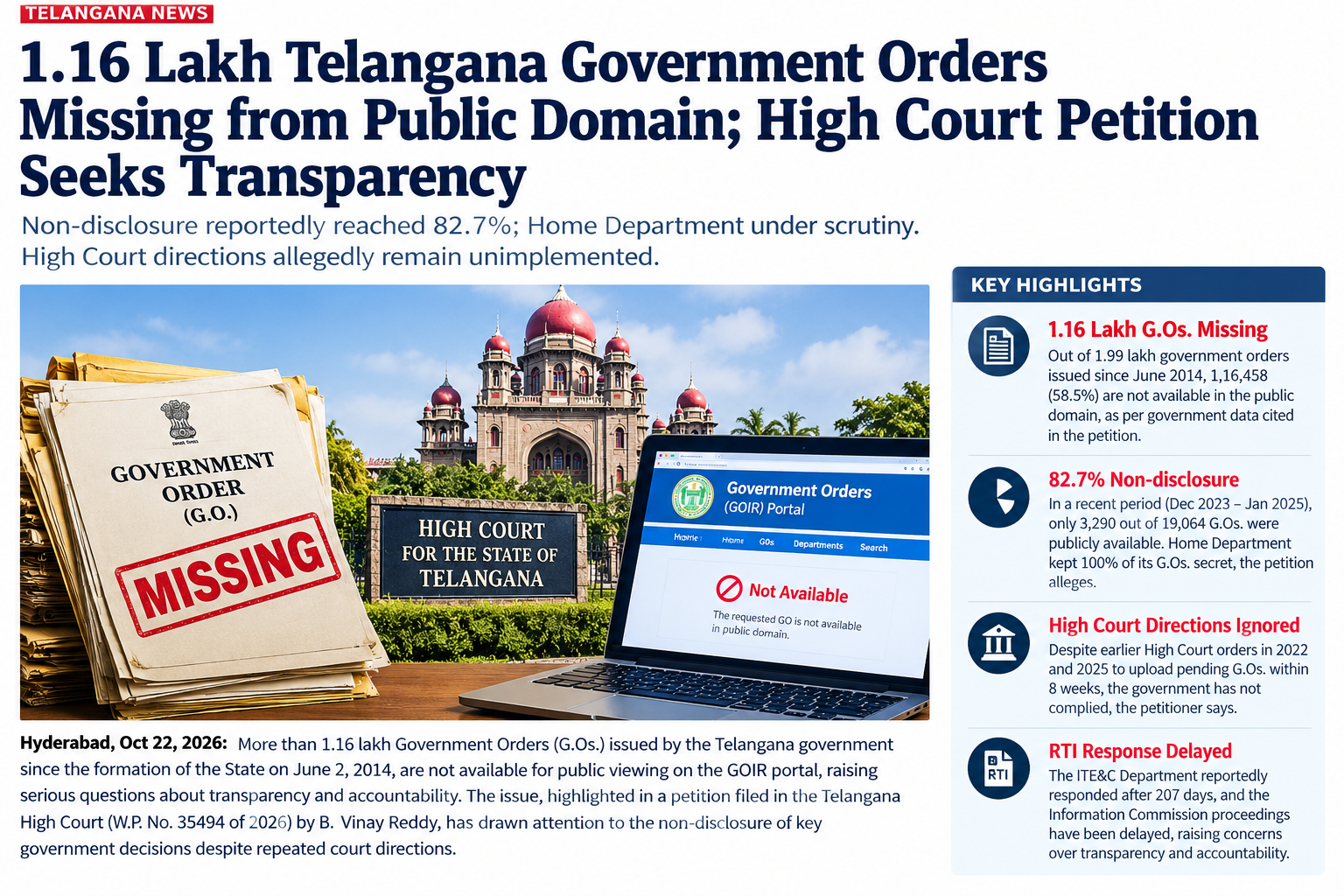
TELANGANA: More than 1.16 lakh Government Orders (G.Os.) issued by the Telangana government since the formation of the State on June 2, 2014, are not available for public viewing on the Government Orders and Issued Records (GOIR) portal, raising serious questions about transparency, accountability and the public’s right to know how government decisions are made.
According to figures cited in a press note issued by B. Vinay Reddy in connection with Telangana High Court W.P. No. 35494 of 2026, the government informed the Legislative Assembly on March 15, 2025, that 1,99,115 G.Os. had been issued between June 2, 2014, and March 14, 2025, but only 82,657 were available in the public domain. This leaves 1,16,458 G.Os., or approximately 58.5 per cent, outside public view.
Press Note.pdf
The issue spans two successive political administrations: the Bharat Rashtra Samithi (BRS), formerly the Telangana Rashtra Samithi (TRS), which governed from 2014 to December 2023, and the Indian National Congress government that took office in December 2023. Both administrations have spoken publicly about transparent governance, but the figures cited in the petition raise a fundamental question: if government decisions are taken in the public interest, why are so many Government Orders not accessible to the public?
The non-publication of G.Os. does not, by itself, establish corruption or deliberate collusion. However, the scale of non-disclosure, the absence of publicly stated reasons for individual classifications and the alleged non-compliance with court directions warrant a transparent, department-wise explanation and independent scrutiny.
Non-disclosure reportedly reached 82.7%; Home Department under scrutiny
The petition also cites an RTI response dated November 18, 2025, which reportedly showed that only 3,290 of 19,064 G.Os. issued between December 7, 2023, and January 26, 2025, were publicly available. This means approximately 82.7 per cent were not available for public viewing during that period. The press note further alleges that the Home Department kept 100 per cent of its G.Os. out of public view. These claims call for detailed clarification from the government and the departments concerned.
The key concern is whether G.Os. are being classified as “Internal” without recording legally sustainable reasons. The petitioner contends that departments can select “Public” or “Internal” publication modes on the GOIR portal without issuing reasoned orders under Sections 8 or 9 of the Right to Information Act, 2005.
While the law permits withholding certain information under specified exemptions, the blanket or routine non-publication of government decisions raises questions about whether those exemptions are being applied appropriately.
Website shutdown in 2016 triggered transparency concerns
Concerns over the accessibility of Telangana’s Government Orders date back to February 2016, when the GOIR portal was reportedly shut down without prior public intimation.
According to the background provided in connection with the issue, Dasoju Sravan Kumar approached the Telangana High Court, seeking restoration of the website. The episode raised concerns about public access to official decisions and the importance of maintaining a transparent digital record of government orders.
The subsequent legal and administrative developments have not resolved the larger issue of access to G.Os. The current petition seeks publication of orders issued since the formation of Telangana, subject to legally justified exceptions.
High Court directions allegedly remain unimplemented
The legal history cited in the press note includes the following developments:
- April 10, 2017: The government issued G.O.Ms.No.4, providing for compliance with government website guidelines, appointment of Web Information Managers in departments and a nodal role for the ITE&C Digital Media Wing.
- March 10, 2022: In W.P. (PIL) No. 121 of 2019, the High Court directed the government to upload pending G.Os. within eight weeks.
- December 23, 2025: In W.P. No. 39547 of 2025, the High Court reportedly reiterated the direction. According to the press note, the eight-week deadline expired on February 17, 2026.
- July 24, 2026: In contempt proceedings, C.C. No. 3402 of 2026, notice before admission was ordered, according to the petitioner.
The petitioner maintains that the directions have not been implemented. The government’s response and the current status of compliance are crucial to establishing the extent of any continuing failure.
RTI application delayed by 207 days
The case also raises questions about the handling of requests for information within the government machinery.
B. Vinay Reddy filed an online RTI application with the Public Information Officer of the ITE&C Department on January 17, 2026, seeking year-wise and department-wise data on G.Os. issued and uploaded since 2014, reasons for non-publication and the applicable rules.
According to the press note, the portal recorded a deemed refusal on February 16, 2026. The First Appeal, filed on February 22, was also recorded as deemed refused on March 24. The PIO eventually replied on August 12, 2026, stating that the subject was “not in the purview” of the department—207 days after the original application.
On October 7, the PIO reportedly sought additional time from the Information Commission, stating that the file was “under circulation”. The petitioner argues that internal file circulation cannot justify exceeding the statutory time limit for responding to an RTI request.
Information Commission proceedings also questioned
Reddy’s complaint to the Telangana Information Commission, filed on February 22, 2026, was reportedly registered as Complaint No. 4633/SIC-AR/2026 only on July 15, after 143 days.
The press note states that the matter was listed on August 13, September 8 and October 13 without a decision. The petitioner also alleges that hearing order sheets were not supplied, a request for video-conference access was not acted upon and the October 13 hearing ended in an adjournment without a fresh date.
These are allegations made by the petitioner and require a response from the Commission. The availability of hearing records, written orders and remote participation facilities is essential to ensuring procedural transparency.
Petition seeks publication of all G.Os. since June 2014
In W.P. No. 35494 of 2026, filed through advocate Mahesh Mamindla, Reddy has sought directions requiring the State government to:
- Publish all Government Orders issued since June 2, 2014, on the GOIR portal, except those lawfully withheld through reasoned orders.
- Disclose department-wise figures showing the number of G.Os. withheld from public view.
- Provide the requested information free of cost within two weeks.
- Appoint Web Information Managers as required under G.O.Ms.No.4.
- Ensure timely video-conference hearings, advance written notices, publication of hearing orders and disposal of the pending Information Commission complaint.
- Provide the Commission with the infrastructure and funding necessary for hybrid hearings.
The petition also seeks interim relief through four connected applications. These are the reliefs requested by the petitioner; they should not be construed as final judicial findings.
Where is the accountability?
The controversy raises a question that neither political slogans nor press conferences can answer: why should citizens have to approach courts repeatedly to obtain access to government decisions that ought to be publicly available by default?
When more than half of the G.Os. in the government’s own reported figures are outside public view, the State must explain which departments withheld them, under what legal authority, and why earlier directions to publish pending orders have allegedly not resulted in compliance.
The issue also has significant implications for public expenditure. Without access to relevant G.Os., citizens, journalists and public-interest organisations may find it harder to scrutinise administrative approvals, land allocations, contracts, concessions, appointments and policy decisions. However, the actual financial loss, if any, cannot be quantified from the number of unavailable G.Os. alone; it requires examination of the underlying orders and their financial consequences.
Any suggestion that officials and political leaders deliberately colluded to conceal orders or cause losses to the exchequer must be established through evidence and investigation, rather than assumed solely from non-publication.
Both the previous BRS government and the present Congress government face a common test of transparency: disclose the records, explain lawful exceptions and demonstrate compliance with court directions.
The demand is straightforward: make publication the rule, provide legally recorded reasons for every exception, and establish accountability for unexplained non-disclosure.
Contact: gsrao@way2rti.com