RTI Puts Gram Panchayat Assessment Under Question
An RTI application by Ganji Srinivasa Rao raises questions about property-tax assessment, public revenue and the development rights of ordinary rural citizens
Hyderabad:
What happens when a common citizen asks a simple question about government revenue?
Sometimes, the answer can reveal a much bigger public-interest issue.
An RTI application filed by RTI activist and social activist Ganji Srinivasa Rao concerning the Administrative Building at Ramoji Film City has raised questions about property-tax assessment and collection.
The issue is not merely about one building. It raises a fundamental public-interest question:
If government revenue was legally due but was not properly assessed or collected, who is responsible for the resulting loss to the public exchequer?
The RTI Journey
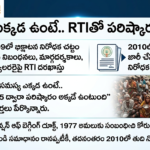
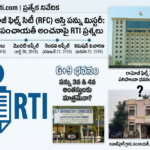
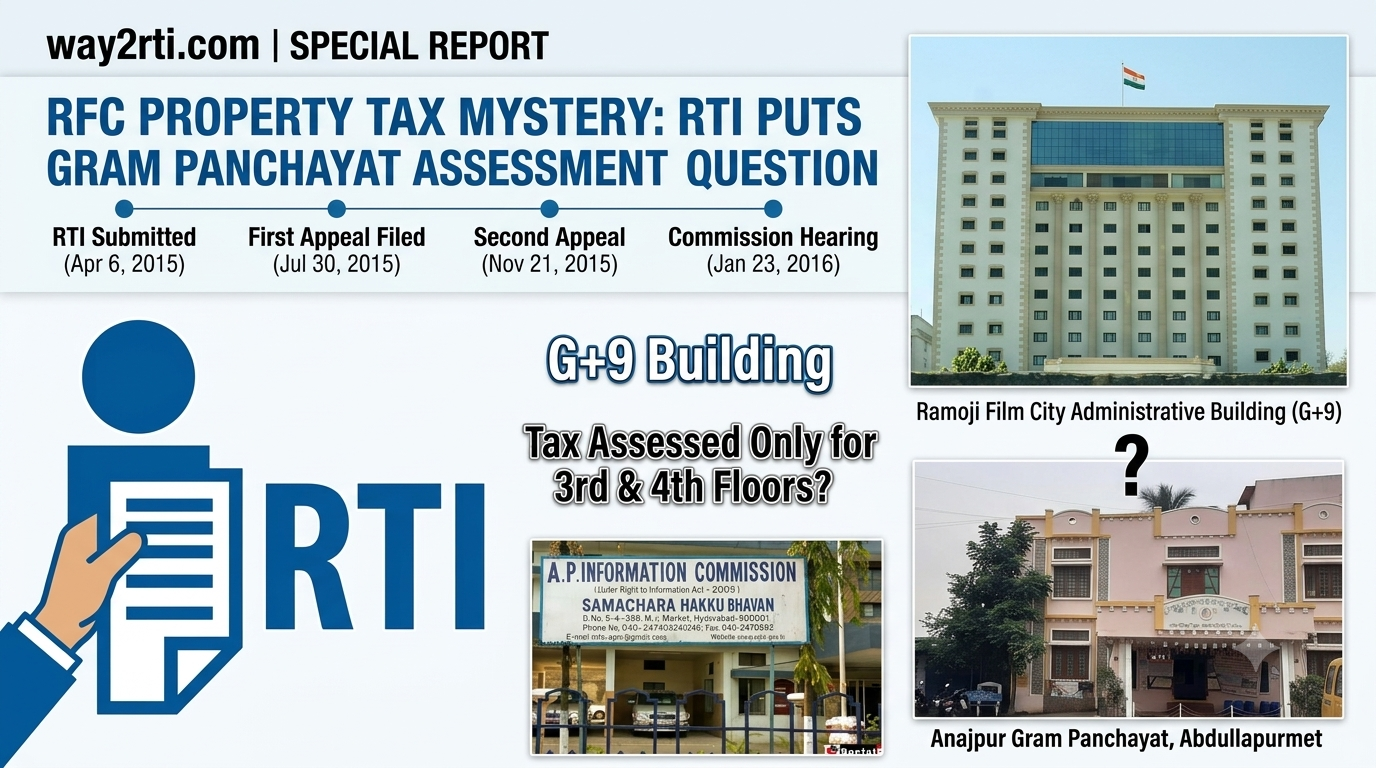
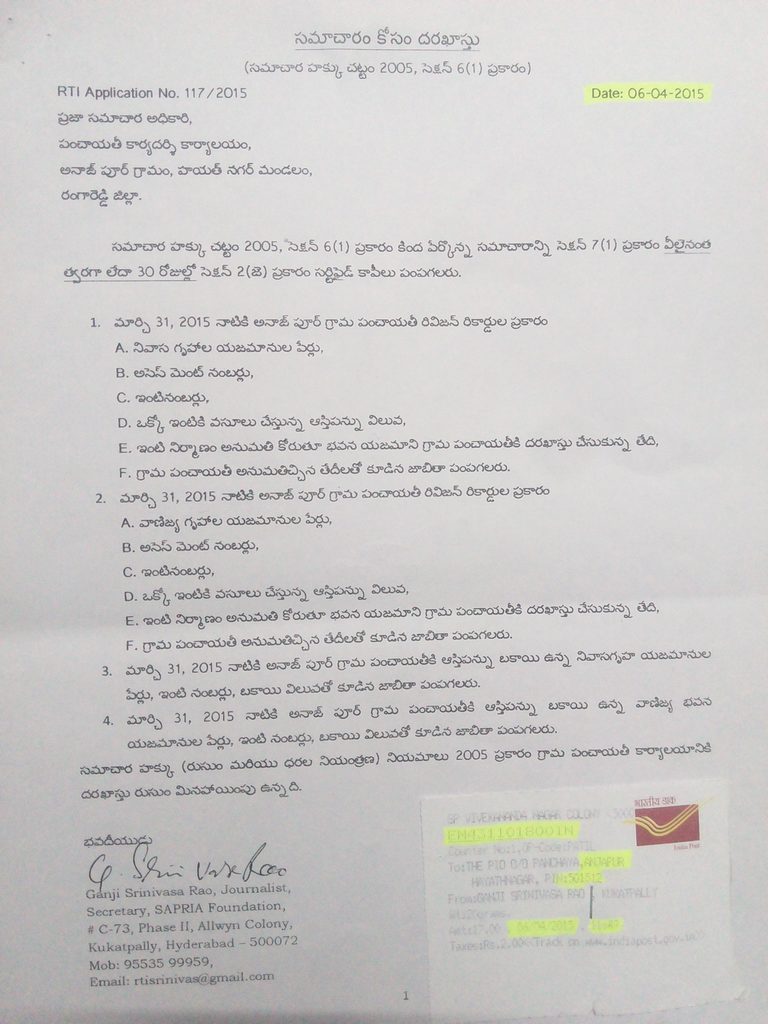
On April 6, 2015, Ganji Srinivasa Rao submitted an RTI application to the concerned Gram Panchayat Secretary, seeking information relating to property-tax assessment.
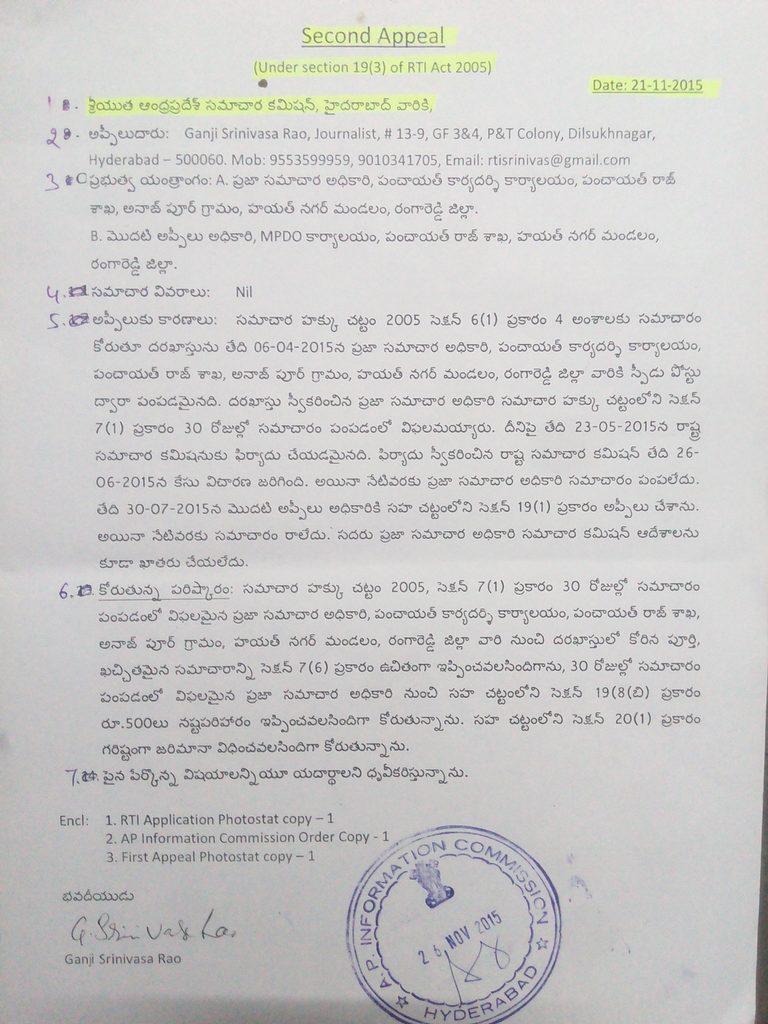
When the information was not furnished within the statutory 30-day period, he filed a First Appeal under Section 19(1) of the RTI Act on July 30, 2015, before the MPDO Office, Hayathnagar.
As the matter remained unresolved, a Second Appeal under Section 19(3) was filed on November 21, 2015.
The case came up for hearing before the State Information Commission on January 23, 2016.
Following the proceedings, information relating to property-tax assessments of buildings at Ramoji Film City for the 2015–16 financial year was furnished to the applicant.
What Did the RTI Information Reveal?
The Administrative Building is described as a Ground Floor plus nine floors (G+9) structure.
According to the RTI information cited by Ganji Srinivasa Rao, property tax was assessed only for the 3rd and 4th floors.
The concerned local body was Anajpur Gram Panchayat, then under the Hayathnagar area of Rangareddy District and now associated with Abdullapurmet.
The assessment cited for the two floors in 2016 was:
- Property tax: ₹57,304
- Library tax: ₹4,584
- Total: ₹61,888
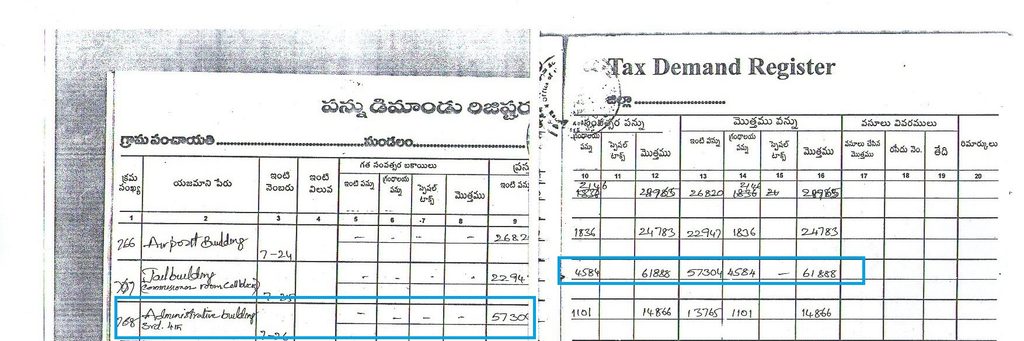
Based on the same calculation, the applicant raised questions about the assessment applicable to the remaining floors.
However, whether the remaining floors were legally taxable, exempt, separately assessed or otherwise treated requires verification from the original assessment records and the applicable rules.
WHERE IS THE PUBLIC LOSS?
This is the critical public-interest question.
Property tax is public revenue collected by the local government for public purposes.
If a property is legally liable for tax and the tax is not properly assessed or collected, the issue potentially involves loss of revenue to the public exchequer.
And ultimately, who bears the burden?
The ordinary citizen.
Especially people living in rural and semi-rural areas who depend on local bodies for basic development:
- Roads
- Drainage
- Drinking water
- Street lighting
- Sanitation
- Public infrastructure
- Village development works
- Other essential civic services
Every rupee of government revenue that is legally due but not collected can potentially mean fewer resources available for public development.
Therefore, this issue should not be viewed simply as a dispute concerning property tax on one private establishment.
It raises a larger question about equal taxation, protection of public revenue and accountability of local authorities.
IS THIS CHEATING? IS IT A CRIME?
This is perhaps the strongest question arising from the RTI findings.
If property tax was deliberately avoided or suppressed, is that cheating?
If officials knowingly failed to assess or collect legally payable tax, does it amount to misconduct or an offence?
If there was a deliberate understanding between private parties and officials, what legal action should follow?
If it was merely an administrative or assessment error, who was responsible and why was it not corrected?
These questions cannot be answered merely through assumptions.
They require examination of the original property-tax assessment records, building plans, inspection reports, demand registers, payment records, applicable rules, exemptions and orders of the competent authority.
If an inquiry establishes deliberate wrongdoing, the responsible persons should face action under the applicable law.
If it establishes only an administrative error, the authorities should determine responsibility, correct the assessment and recover any legally recoverable arrears.
WHAT ABOUT OTHER BUILDINGS?
Another important question follows.
If the Administrative Building was assessed in this manner, citizens have a right to ask:
How were the other buildings at Ramoji Film City assessed?
- Were all buildings properly assessed?
- Was the complete built-up area recorded?
- Were all floors included?
- Were assessments periodically revised?
- How much tax was demanded?
- How much was actually collected?
- Were there arrears?
- Were any exemptions granted?
- If so, under what legal provision?
- Was any tax subsequently recovered?
A comprehensive assessment or audit could answer these questions.
THE COMMON MAN DESERVES EQUAL TREATMENT
A small shopkeeper or ordinary homeowner cannot simply refuse to pay property tax.
If tax is legally assessed, the citizen is expected to pay.
Then the natural question is:
Should the same legal standards not apply to large commercial and institutional properties as well?
Public revenue must be protected irrespective of who owns or occupies a property.
No citizen should receive special treatment in taxation merely because of status, wealth, influence or prominence.
RTI GIVES THE COMMON MAN A VOICE
The important lesson from this case is that Ganji Srinivasa Rao, as an ordinary citizen and RTI activist, did not need political power to ask these questions.
He used the RTI Act, 2005, pursued the matter through the statutory appeal mechanism and eventually obtained government records.
That is the power of RTI.
Instead of merely alleging:
“There is corruption.”
Ask for the records.
Instead of saying:
“Tax is being evaded.”
Obtain the assessment and collection records.
Instead of making assumptions:
“Who benefited?”
Ask for the official documents and follow the records.
ASK. OBTAIN. VERIFY. QUESTION. ACT.
A QUESTION FOR TELANGANA
The issue ultimately goes beyond Ramoji Film City.
It concerns every Gram Panchayat and local body in Telangana.
Are all properties being assessed fairly?
Is every rupee of legally payable property tax being collected?
Is public revenue being lost because of negligence, favouritism or deliberate inaction?
If public money is lost, who will be held accountable?
And most importantly:
If legally payable public revenue is deliberately allowed to escape collection, is it merely an “assessment error”—or can it constitute cheating, misconduct or a criminal offence?
The answer should come from official records, a proper inquiry and the law—not from assumptions.
Because every rupee lost from the public exchequer ultimately belongs to the people.
For an ordinary rural family waiting for a road, drainage facility, drinking water or other basic development work, public revenue is not just a number on a government register. It is money meant for public development.
Way2RTI.com | Awareness Through RTI
Note: Are you interested in filing an RTI application on the above issue? Interested citizens may send their details to our official email: gsrao@way2rti.com