Nodal Department Failed to Furnish Its Own Section 4(1)(b) Disclosure Information, Alleges RTI Activist
“Justice delayed is justice denied; information delayed defeats the very purpose of the RTI Act.”
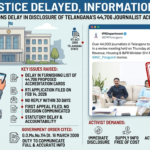
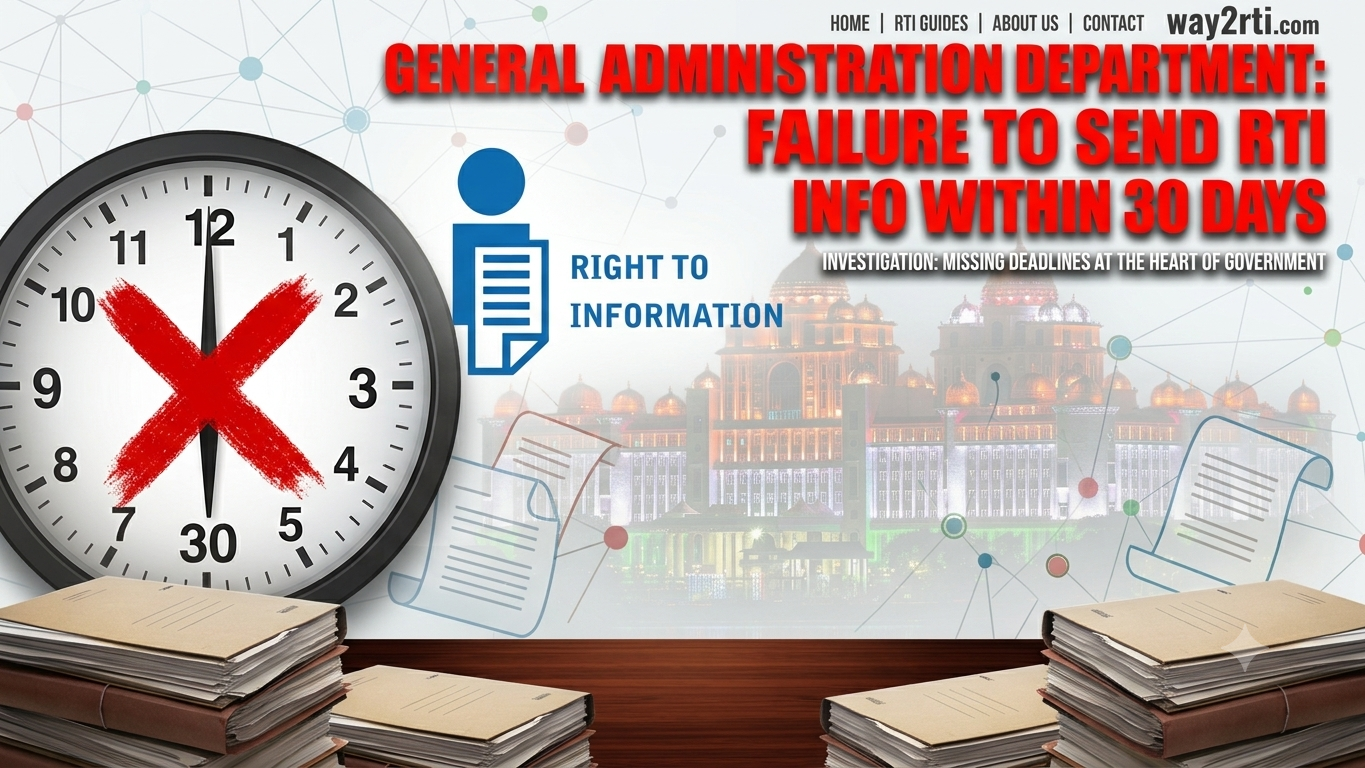
RTI Consultant and Social Activist Ganji Srinivasa Rao has raised serious questions over the functioning of the General Administration Department (GAD), Government of Telangana, after the Public Information Officer (PIO) allegedly failed to furnish information sought regarding the Department’s Suo-Motu Disclosure obligations under Section 4(1)(b) of the Right to Information Act, 2005.
Rao submitted RTI Application No.99/2026 dated 21.05.2026 to the PIO, Office of the Special Chief Secretary, General Administration Department, Secretariat, Hyderabad. The application was dispatched by Speed Post on 22.05.2026.
Information sought on Section 4(1)(b) disclosure
The RTI application sought the complete and updated Section 4(1)(b) Information Manual relating to the Office of the Special Chief Secretary, GAD, including details of its organisation, functions, powers and duties of officers, decision-making procedures, rules and manuals, categories of records, committees, employee directory, remuneration, budget, concessions and permits, electronic information, facilities for citizens and PIO details.
The applicant also sought the current official website/URL where such information was published and requested the records in electronic PDF format.
PIO allegedly failed to respond within 30 days
According to Rao, no reply or information was received from the PIO within the statutory period prescribed under Section 7(1) of the RTI Act, 2005.
He subsequently filed a First Appeal under Section 19(1) dated 02.07.2026, dispatched by Speed Post on 03.07.2026.
The appellant states that the PIO reply remained “NIL” and that the First Appellate Authority (FAA) also failed to pass an effective order within the period prescribed under Section 19(6).
GAD’s own RTI Nodal Officer instructions now under scrutiny
The matter assumes greater significance because of U.O. Note No.33583/RTIA/GPM&AR/2011, dated 27.10.2011, issued by the General Administration Department, Government of Andhra Pradesh, concerning the appointment and functioning of RTI Nodal Officers.
The circular prescribed an institutional mechanism for coordinating RTI applications and appeals in public authorities having more than one PIO.
What the 2011 circular required
According to the circular, public authorities having more than one PIO were required to immediately appoint a Nodal Officer to coordinate RTI-related matters.
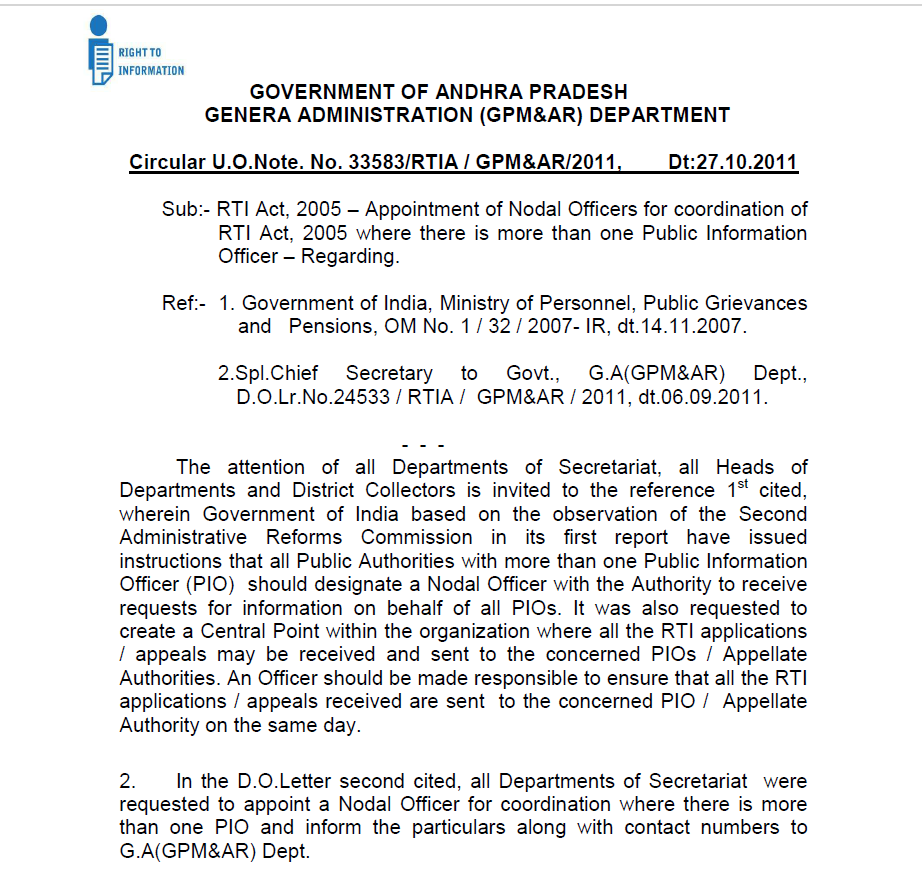
The prescribed responsibilities included:
- Establishing a central point for receiving RTI applications and appeals;
- Forwarding applications and appeals to the concerned PIO or First Appellate Authority on the same day;
- Maintaining a dedicated register for monitoring RTI applications and appeals;
- Ensuring timely submission of required reports to the Information Commission;
- Collecting and maintaining the contact details of RTI Nodal Officers; and
- Ensuring that the relevant contact details were communicated to the Information Commission for public access.
The circular further directed Secretariat Departments, Heads of Departments and District Collectors to ensure compliance and furnish the details of Nodal Officers, or the single PIO where only one PIO existed.
Why this is important in the present case
The existence of such an institutional mechanism raises an important question: if the Government had already prescribed procedures for centralised monitoring and timely forwarding of RTI applications and appeals, why was the applicant’s request allegedly not answered within the statutory period?
The issue is particularly significant because the present RTI application itself concerns transparency and proactive disclosure by a Government department.
If the relevant office has a Nodal Officer, the authorities may clarify whether the application was entered in the prescribed register, whether it was forwarded to the concerned PIO within the prescribed procedure, and whether any monitoring mechanism was activated when the statutory deadline approached.
Section 4 disclosure is a statutory obligation
Section 4(1)(b) of the RTI Act requires public authorities to proactively publish specified information relating to their functioning and administration.
The provision also requires such publications to be updated every year.
The original statutory requirement was to publish the Section 4(1)(b) information within 120 days from the commencement of the Act. Since the RTI Act came into force on June 15, 2005, the 120-day period expired on 12 October 2005.
Therefore, according to the applicant, the question is not simply whether information existed in 2026, but whether the public authority has properly maintained, updated and proactively disclosed the information required by law.
Nodal department and RTI implementation
The applicant contends that GAD’s position is particularly important because it has a coordinating/nodal role in the State Government’s administrative implementation of the RTI framework.
The 2011 U.O. Note itself demonstrates that the Government had recognised the need for an organised system for receiving, forwarding, registering and monitoring RTI applications and appeals.
Rao therefore questions whether the prescribed system is presently functioning effectively and whether it was followed in his case.
Can the PIO automatically be called an accused?
Legally, failure to respond within the statutory period does not by itself establish criminal guilt or make a PIO an “accused.”
However, the RTI Act provides specific consequences for unjustified delay.
Under Section 20(1), the Information Commission may impose a penalty of ₹250 per day, subject to a maximum of ₹25,000, where the statutory conditions are established and the PIO has failed to show reasonable cause.
Under Section 20(2), the Information Commission may recommend disciplinary action where the conduct of the PIO warrants such action.
Therefore, whether the delay resulted from negligence, administrative failure, deliberate non-compliance or a reasonable cause has to be determined through the statutory process after giving the concerned officer an opportunity to explain.
Applicant’s demands
Rao has sought:
- Immediate furnishing of the complete Section 4(1)(b) information;
- Supply of delayed information free of cost under Section 7(6);
- Details of the current RTI Nodal Officer and the mechanism followed for handling RTI applications;
- Verification of whether the 27.10.2011 Nodal Officer instructions are being implemented;
- Examination of responsibility for the delay;
- Consideration of penalty under Section 20(1) wherever legally warranted; and
- Appropriate action under Section 20(2) if the statutory requirements are found to have been violated.
The larger transparency question
The case raises a fundamental question:
If the department responsible for coordinating RTI implementation has itself prescribed a system for monitoring RTI applications and appeals, but a citizen’s RTI application allegedly remains unanswered beyond the statutory period, who is accountable for the failure?
The purpose of the RTI Act is not merely to provide information after prolonged correspondence. Its broader objective is to promote transparency, accountability and proactive disclosure in public administration.
The present matter therefore raises questions concerning Section 4 compliance, PIO accountability, appellate supervision and implementation of the Government’s own RTI coordination mechanism.
Any finding of deliberate or mala fide non-compliance, however, must be based on the official records and due statutory inquiry.
Way2RTI.com will continue to follow the matter and examine the response and action taken by the competent authorities.
Legal Provisions Involved
Right to Information Act, 2005
- Section 4(1)(b) – Proactive/Suo-Motu disclosure
- Section 4(1)(c) & 4(1)(d) – Publication of relevant information and reasons for administrative decisions
- Section 6(1) – RTI application
- Section 7(1) – Disposal within prescribed period
- Section 7(6) – Information to be provided free of charge where statutory time limit is violated
- Section 19(1) – First Appeal
- Section 19(6) – Disposal of First Appeal
- Section 20(1) – Penalty on PIO
- Section 20(2) – Recommendation for disciplinary action
Government Instruction
U.O. Note No.33583/RTIA/GPM&AR/2011, dated 27.10.2011 – Instructions concerning appointment and functioning of RTI Nodal Officers and coordination of RTI applications and appeals.
RTI • Transparency • Public Accountability • Citizen Awareness
Note: Are you interested in filing an RTI application on the above issue? Interested citizens may send their details to our official email: gsrao@way2rti.com