CMO Telangana Rejects RTI on Sarees and Video-Conference Participants: Does Section 2(f) Justify Denial of Existing Records?
This makes questions concerning saree design, sample approval, procurement, production, specifications, expenditure and distribution matters of legitimate public interest.
Telangana: A Right to Information application filed by RTI Advisor and Social Activist Ganji Srinivasa Rao before the Public Information Officer (PIO), Chief Minister’s Office (CMO), Telangana, has raised important questions about how the RTI Act, 2005 is being interpreted by a high-level public authority.
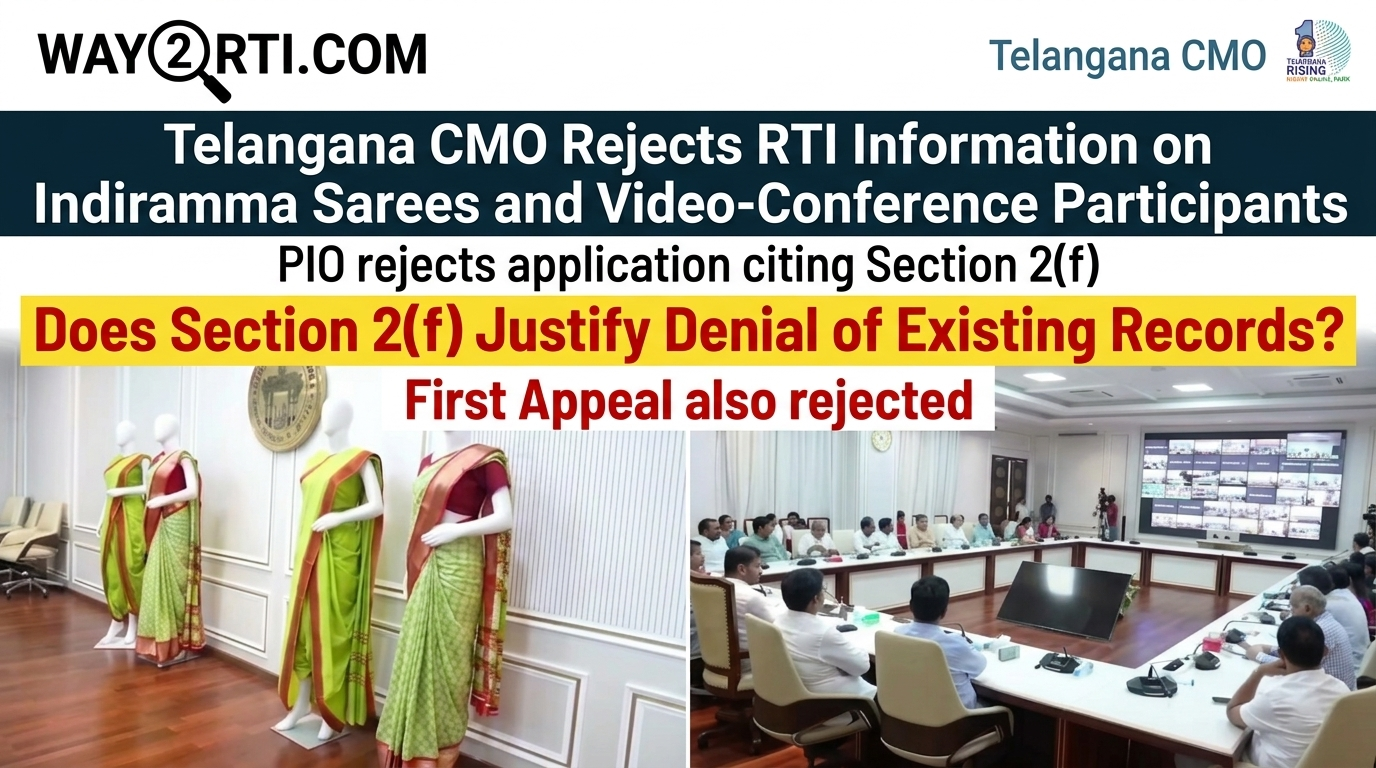
The dispute concerns an official CMO Telangana Facebook reel/video showing sarees and a video conference held at the Telangana Secretariat in the presence of Chief Minister A. Revanth Reddy.
Srinivasa Rao filed RTI Application No. 131/2026 dated 09 June 2026, seeking two specific categories of information.
What was sought under RTI?
Point 1: Sample sarees corresponding to those displayed in screenshots taken from the official CMO Telangana Facebook reel/video. The applicant specifically stated that he was willing to pay the prescribed charges for the samples.
Point 2: Names, designations, departments and complete postal addresses of officials, non-officials and public representatives who participated in the video conference shown in the CMO reel/video.
The applicant requested the information in soft-copy format through email.
PIO rejects application citing Section 2(f)
The PIO & Assistant Secretary to the Chief Minister, CMO, Telangana, issued Letter No. 181/PAGB/RTI(CM)/2026 dated 17 June 2026, rejecting the request.
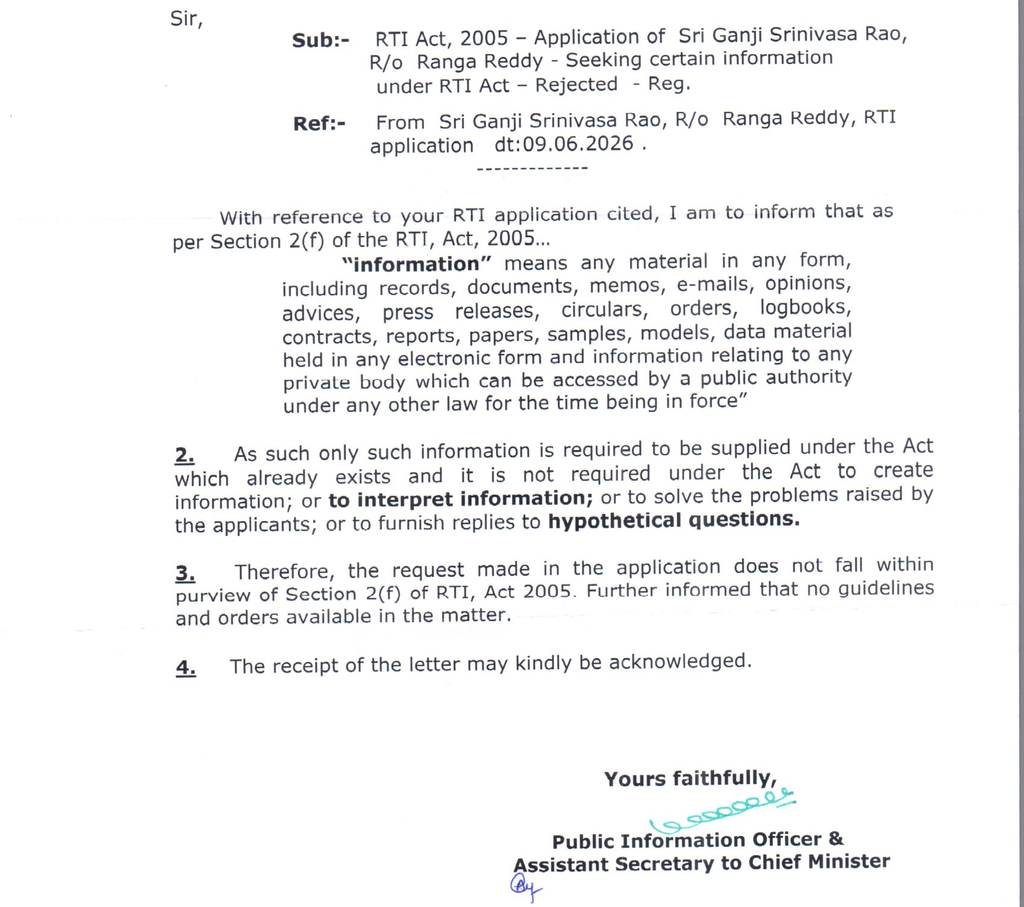
The reply relied principally on the definition of “information” under Section 2(f) and stated that the RTI Act does not require a public authority to create information, interpret information, solve problems or answer hypothetical questions.
The PIO also stated that no guidelines or orders were available in the matter.
But this raises a fundamental question:
Was the RTI application actually asking the CMO to “create” information—or was it seeking material and records already held by, or available to, the public authority?
RTI Act expressly includes “samples”
Section 2(f) of the RTI Act defines information broadly to include material in any form, including records, documents, emails, opinions, orders, reports, papers, samples, models and data material held electronically.
More importantly, Section 2(j) recognises the right to obtain certified samples of material. The Supreme Court has also reproduced these statutory provisions while explaining the scope of the right to information.
The Telangana RTI Rules separately prescribe charges for priced material, including samples and models, indicating that samples are not inherently outside the RTI framework.
Therefore, the critical issue is not simply whether the CMO is required to manufacture a new saree for an applicant.
The real transparency question is:
If the sarees displayed in the official government programme were government-procured, government-approved, government-produced or otherwise available in official custody, what records exist concerning their procurement, approval, design, specifications, samples and availability?
Second question: Who participated in the official video conference?
The second RTI point sought the names, designations, departments and postal addresses of persons participating in the video conference shown in the official CMO video.
Again, the issue is whether such information exists in official records.
Government programmes and video conferences can potentially generate records such as invitations, participant lists, attendance records, proceedings, correspondence, schedules, official communications, photographs, video records and other documentation.
If such records exist, the question arises whether the applicant’s request could have been answered by providing the existing records, rather than rejecting the entire application on the general proposition that public authorities need not create information.
Section 7(1): a significant legal question
Section 7(1) provides that a PIO shall either provide information or reject the request for reasons specified in Sections 8 and 9 of the RTI Act.
In this case, according to the documents supplied by the applicant, the PIO’s rejection was based on Section 2(f), rather than invoking a specific exemption under Section 8 or Section 9.
This creates an important legal issue for examination by the appellate authority and, if necessary, the Telangana State Information Commission:
Can a request be rejected merely because the PIO considers it to involve creation or interpretation of information, without first determining whether any corresponding existing records are held by the public authority?
The answer may depend upon the precise nature of the records actually held by the CMO and the wording of each RTI point.
First Appeal also rejected
Srinivasa Rao filed a First Appeal on 30 June 2026.
The First Appellate Authority & Additional Secretary to Government (Accommodation), General Administration Department, Telangana Secretariat, issued Letter No. 181/PAGB/RTI(CM)/2026-2 dated 07 July 2026.
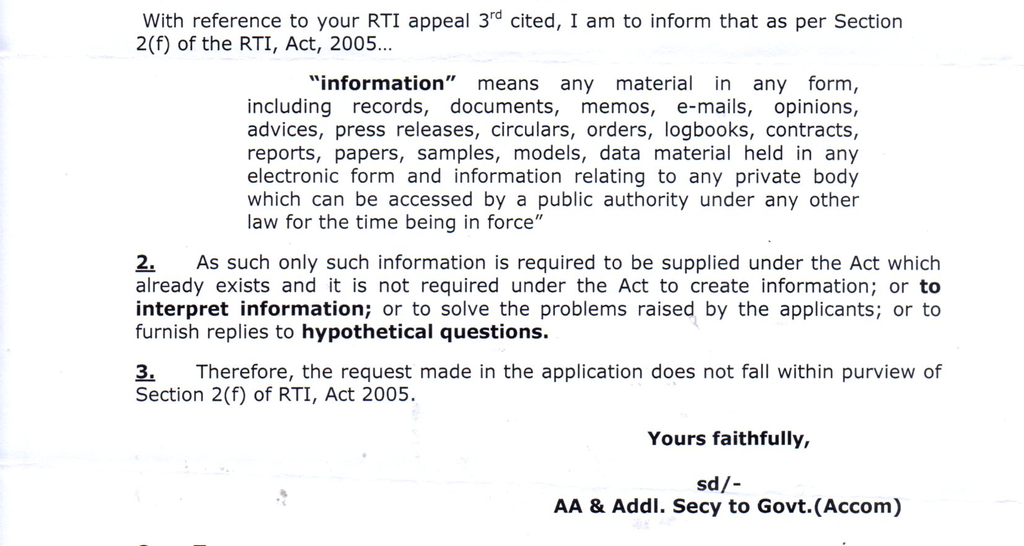
The FAA upheld the PIO’s position and again relied upon Section 2(f), stating that public authorities are not required to create data, provide interpretations or answer hypothetical questions.
The First Appeal was consequently rejected.
Complaint alleges statutory failure
Following the FAA’s order, Srinivasa Rao submitted a complaint on 15 July 2026 to the Nodal Officer concerned with implementation of the RTI Act.
The complaint alleges failure to comply with the statutory obligations of the RTI Act and seeks enquiry and appropriate disciplinary action against the PIO and FAA.
The applicant has relied, among other provisions, upon G.O.Ms.No.114, General Administration Department, dated 16 March 2009, the RTI Act and relevant Information Commission decisions and Government of India memoranda.
Indiramma sarees make the RTI question even more relevant
The issue has gained renewed public relevance because Telangana is currently preparing a large number of Indiramma sarees for distribution to women.
Reports in 2026 stated that the State government had ordered one crore parrot-green sarees, with a reported ₹450-crore production contract, and that the new design was unveiled at a Secretariat programme attended by the Chief Minister, ministers and senior officials.
A recent Telugu report also stated that production of the sarees was progressing and that orders had been placed for millions of metres of cloth, with ₹450 crore allocated for the programme.
This makes questions concerning saree design, sample approval, procurement, production, specifications, expenditure and distribution matters of legitimate public interest.
Transparency versus “creation of information”
The Telangana Government’s own RTI portal states that the fundamental objectives of the RTI Act include empowering citizens, promoting transparency and accountability, containing corruption and making government more accountable to citizens.
The RTI Act therefore requires a careful distinction between:
Information that does not exist and would genuinely require creation, and
Existing records that can be identified, inspected, copied or supplied to an applicant.
That distinction is particularly important where the information relates to an official government programme publicly displayed through an official government social-media account.
Questions for the Telangana State Information Commission
The matter raises several questions that deserve consideration:
- Does Section 2(f) exclude all requests involving samples when the Act itself expressly includes “samples” within the definition of information?
- Did the CMO ascertain whether records relating to the saree samples, designs, specifications, approvals, procurement or production existed before rejecting Point No. 1?
- Did the CMO verify whether participant lists, attendance records, official correspondence or other records existed concerning the video conference?
- Can an entire RTI application be rejected as hypothetical when portions of the requested information may exist in documentary or electronic records?
- If information is available in existing records, should those records be supplied rather than requiring the PIO to create a fresh answer?
- Does the rejection comply with the requirements of Section 7 of the RTI Act?
- If the Commission finds that information was wrongly denied, what relief should be granted to the applicant under the RTI Act?
Penalty and disciplinary provisions
The RTI Act provides a mechanism for the Information Commission to consider penalty where a PIO, without reasonable cause, refuses information, knowingly provides incorrect, incomplete or misleading information, or otherwise obstructs furnishing of information. Section 20 also provides for consideration of disciplinary action in specified circumstances of persistent failure.
However, whether those provisions apply in this particular case is ultimately a matter for the competent Information Commission to determine after examining the records, explanations and applicable law.
The larger public-interest issue
The controversy is not merely about a saree.
It concerns a broader question:
When an official government programme is publicly displayed by the Chief Minister’s Office, how much documentary information should remain accessible to citizens who seek to understand the government’s decisions, expenditure, procurement, participants and implementation?
The RTI Act was enacted to create a practical regime for citizens to access information under the control of public authorities and to promote transparency and accountability.
For Way2RTI, the central issue is therefore straightforward:
If the record exists, disclose the record. If the record does not exist, clearly state that it is not available. But should a citizen’s RTI request be rejected without first establishing what records actually exist?
The final determination rests with the appropriate appellate and Information Commission authorities.
Way2RTI.com will continue to follow the matter in the public interest.
Way2RTI.com — RTI Information, Analysis & Citizen Empowerment
Feedback: gsrao@way2rti.com