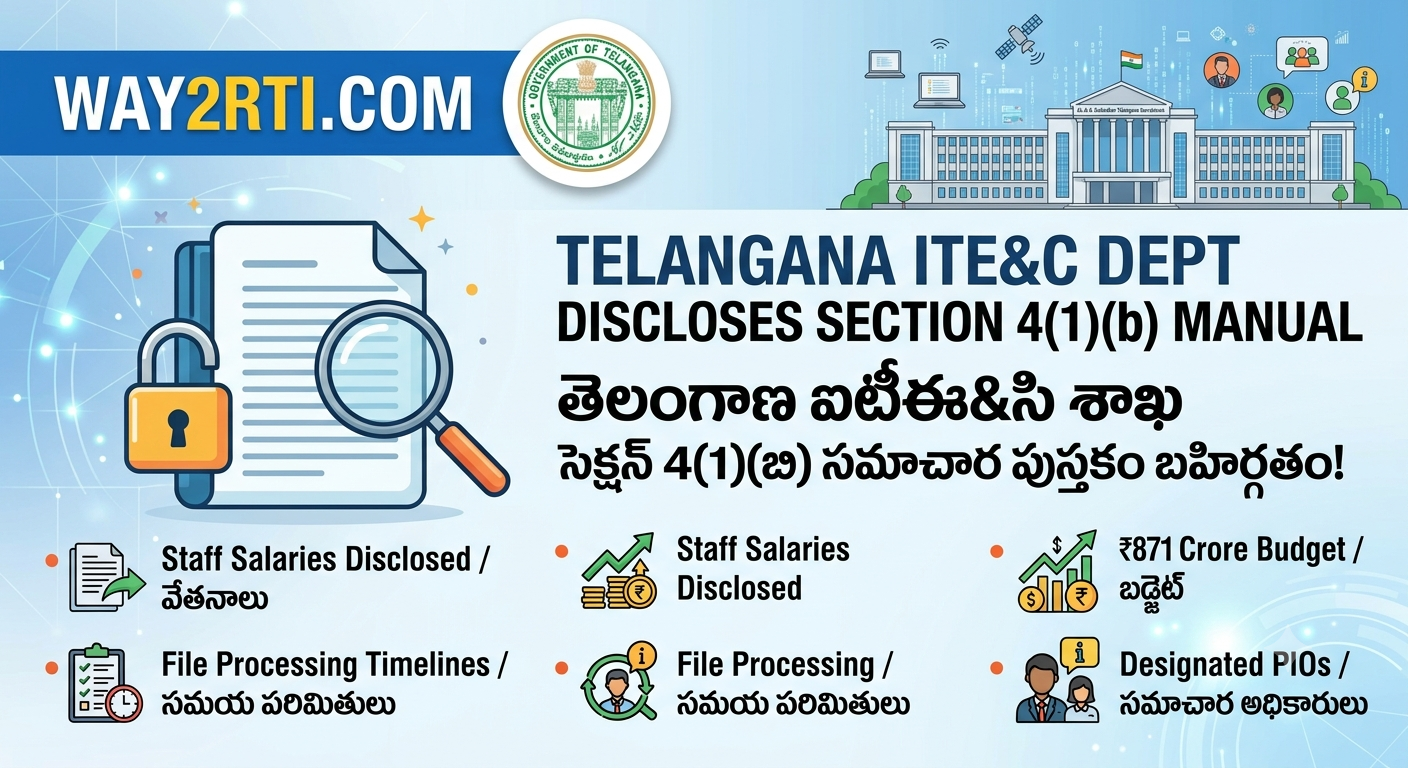
Telangana ITE&C Department’s RTI Disclosure Reveals ₹871.22 Crore Budget, Officer Duties and Public Information Channels
Manual outlines administrative responsibilities, decision-making timelines, staff remuneration and citizens’ right to access government records
HYDERABAD: How does Telangana’s Information Technology, Electronics & Communications (ITE&C) Department function? Who is responsible for administrative decisions? How long should files take to move through the Secretariat? What is the department’s budget? Who should citizens approach when information is denied?
These are important questions for every citizen who seeks transparency and accountability in government administration.
An updated Section 4(1)(b) disclosure manual of the ITE&C Department, described in material relating to an RTI application filed by RTI and Consumer Rights Activist Ganji Srinivasa Rao, provides an 18-chapter overview of the department’s organisational structure, officers’ duties, decision-making process, budget, remuneration details and mechanisms for obtaining information under the Right to Information Act, 2005.
The disclosure offers citizens a practical starting point for understanding how a department operating from the Dr. B.R. Ambedkar Telangana Secretariat is expected to function.
The larger public-interest question is this: Are citizens able to use the information proactively disclosed by the government to monitor administration, seek explanations for delays and hold public authorities accountable?
Why should every citizen read Section 4(1)(b) disclosures?
The Right to Information Act, 2005, is not merely a mechanism for submitting applications and waiting for replies. Section 4 places proactive disclosure obligations on public authorities, helping citizens access important information without having to repeatedly file individual RTI applications.
Such disclosures can help the public understand:
- The department’s functions, powers and responsibilities.
- The duties assigned to officers and employees.
- The procedures followed for administrative decisions.
- The rules, regulations and instructions governing official work.
- The categories of records maintained by the department.
- Budget allocations and other disclosed financial information.
- The names and contact details of Public Information Officers (PIOs) and First Appellate Authorities (FAAs).
When this information is accessible, citizens can frame more precise RTI applications, identify the appropriate authority and ask informed questions about public administration.
1. What does the ITE&C Department do?
According to the disclosure manual, the ITE&C Department functions as the nodal department advising the Telangana Government on information technology, electronics and communications.
Its responsibilities include policy formulation, promotion of IT and electronics investments, e-Governance coordination, digital services, entrepreneurship, student training and skill development.
The manual also identifies responsibilities connected with e-Procurement, e-Auctions, IT parks, special economic zones, hardware clusters and incubation centres.
Public awareness point: Citizens, entrepreneurs, students and businesses seeking information about government IT policies or departmental decisions should first identify which activity falls within the department’s jurisdiction and which records are held by the relevant public authority.
2. Who is responsible for what?
The manual identifies officers and their respective administrative or technical responsibilities.
- Sanjay Jaju, IAS, Special Chief Secretary to Government (FAC): Overall supervision, observance of Business Rules and Secretariat Instructions, allocation of staff work and timely disposal of departmental business.
- Anudeep Durishetty, IAS, Joint Secretary: General supervision and implementation of applicable Business Rules.
- M. Sandhya Rani, Deputy Secretary (Administration): General administration, budget, service matters, vigilance and disciplinary cases.
- C. Naghabhushana Sastry, Assistant Secretary (Administration): Administrative matters, service rules, vigilance and Drawing and Disbursing Officer responsibilities.
- A. Ramkumar, Section Officer (Administration): Routine administration, service matters and assistance in budget preparation.
- Ch. Bharath Reddy, Joint Director (e-Governance): e-Governance programmes, e-Procurement, e-Auctions and operation and maintenance of e-Procurement systems.
- V. Badarinadh, IT Promotion Officer: IT promotion, policy implementation, IT parks, SEZs, hardware clusters and incubation initiatives.
The document also lists personnel responsible for budget preparation, accounts, statistical work and other administrative functions.
This information is useful because citizens can direct requests to the appropriate office instead of submitting applications without identifying the authority that holds the relevant records.
3. How are government files processed?
The disclosure describes a hierarchical process for handling incoming correspondence and administrative files.
Incoming correspondence is registered by the Tappal Clerk. The Assistant Section Officer registers the matter and prepares the file with relevant legal or rule references. The file then moves through the Section Officer, Assistant Secretary and higher Secretariat authorities, depending on the nature of the matter.
The manual states that decisions are governed by the applicable Secretariat Instructions and Business Rules.
This process raises an important public-administration question: when an application, representation or official proposal remains pending, can the citizen identify where it was received, which section handled it and what action was recorded?
Where relevant records exist and are accessible under the RTI Act, citizens can seek copies of file movement entries, recorded action taken, correspondence and orders, subject to applicable legal exemptions.
A file should not become invisible to the citizen merely because it moves from one office to another. Transparency in recorded decision-making is essential for accountability.
4. Are there timelines for processing files?
One of the notable features of the manual is its description of timelines for departmental work.
| Category of work | Timeline stated in the manual |
| Routine internal files | 3 days |
| Non-routine or policy decision files | 10 days |
| Routine inter-departmental references | 3 days |
| Inter-departmental policy files | 7 days |
The manual also lists official working hours as 10:30 a.m. to 5:00 p.m. on working days.
These timelines provide citizens with a basis for understanding the department’s stated administrative norms. However, they should not automatically be interpreted as statutory deadlines applicable to every citizen’s application or grievance. The applicable rules and the nature of the matter must be examined.
When delays occur, citizens can seek available records showing when a matter was received, which officers or sections handled it, what action was taken and whether any recorded reasons explain the delay.
5. What does the disclosed budget reveal?
The manual lists the ITE&C Department’s budget allocation for 2026–27 under Demand No. IX as ₹87,122.51 lakh, equivalent to approximately ₹871.23 crore.
This is a significant figure from a public-accountability perspective. A budget allocation, however, is not the same as actual expenditure, money released, expenditure incurred or the achievement of intended outcomes.
Citizens interested in financial accountability can seek relevant records concerning:
- Budget estimates and revised estimates.
- Funds released and expenditure incurred.
- Scheme-wise or project-wise expenditure, where maintained.
- Procurement decisions, work orders and contracts.
- Utilisation certificates and audit observations, where applicable.
- Project implementation status and recorded outcomes.
These records can help the public distinguish between money allocated, money spent and results delivered.
6. Why is disclosure of staff remuneration important?
The manual includes remuneration figures for several officers and employees. Among the entries, it lists ₹3,00,000 as consolidated monthly remuneration for the IT Promotion Officer and records different amounts for other positions.
Such information can help citizens understand what the department has disclosed about public employment and remuneration.
However, the figures reproduced in the manual should be read in their stated context. They should not be assumed to represent every component of compensation or independently verified current take-home salaries.
For a more complete understanding, citizens may seek the relevant sanctioned posts, appointment or engagement terms, applicable pay scales, remuneration orders and other existing records, subject to the law.
Public money must be administered according to applicable rules, and public records should enable meaningful scrutiny.
7. Which records does the department maintain?
The manual identifies several categories of official documents, including:
- Government Orders (G.O. Ms. and G.O. Rt.).
- Memoranda and official letters.
- U.O. Notes and office orders.
- Endorsements and demi-official letters.
It states that current files are maintained in departmental sections and that legacy or permanent records are archived according to Secretariat Office Manual procedures.
The manual also points to government order portals and the departmental website as information resources.
Citizen action: Before filing an RTI application, check whether the required Government Order, policy, circular or other record is already available online. If it is not available, identify the record precisely and approach the public authority that holds it.
8. Can citizens approach the department when files are delayed?
The manual states that direct public consultation on policy formulation is not applicable to the Secretariat unit, which operates primarily at the executive policy level. It also indicates that citizens facing administrative delays in the issuance of orders may approach officers of the rank of Assistant Secretary and above.
This does not mean citizens lose their statutory rights when a department does not provide information or respond to a request.
The appropriate remedy depends on the nature of the issue. A grievance about administrative delay, an RTI request for existing records and a statutory appeal under the RTI Act are different processes and should not be confused.
Citizens should retain application acknowledgements, reference numbers, correspondence and copies of orders to establish the sequence of events.
9. Who are the RTI officers in the ITE&C Department?
The disclosure identifies the following officers for RTI-related matters:
Public Information Officer (PIO)
C. Naghabhushana Sastry, Assistant Secretary (Administration)
Room No. 31, 3rd Floor, Telangana Secretariat
Phone: 9052224456
Assistant Public Information Officer (APIO)
A. Ramkumar, Section Officer (Administration)
Room No. 25, 3rd Floor, Telangana Secretariat
Phone: 9966709052
First Appellate Authority (FAA)
M. Sandhya Rani, Deputy Secretary to Government (Administration)
Room No. 23, 3rd Floor, Telangana Secretariat
Phone: 9490806415
These names and contact details are reproduced from the supplied disclosure material. Citizens should confirm that the details remain current before relying on them.
Under the RTI Act, a person seeking information can submit an application to the appropriate PIO. If dissatisfied with the response, or if a response is not received within the applicable period, the person may pursue a first appeal under Section 19(1), subject to the Act’s provisions.
A second appeal may be available under Section 19(3), as applicable. The statutory time limits and procedures should be followed.
10. What information should citizens seek when answers are incomplete?
The disclosure manual is a starting point, not a substitute for examining the underlying records.
If a citizen wants to understand how a particular decision was taken, an RTI application may seek copies of the relevant order, file notings, correspondence, recorded approvals and applicable rules, where such records exist and are disclosable.
If the issue concerns public expenditure, the applicant can identify the financial year, project, order number or expenditure category and request the corresponding records.
If the issue concerns delay, the applicant can seek the recorded date of receipt, file movement details, action taken and any recorded reasons for the delay.
Requests should be specific and should seek identifiable information held by or under the control of the public authority. The RTI Act generally provides access to existing records; it does not require a PIO to create new information, conduct fresh research or provide explanations that are not available on record.
Where an exemption is claimed, the relevant legal provision and the particular information withheld should be examined against the Act and the circumstances of the case.
11. What about the department’s other disclosures?
The supplied manual records “Nil” for subsidy programmes and concession or permit recipients within the direct operational scope of the Secretariat unit.
This entry should be interpreted carefully. It does not, by itself, establish that no subsidies, incentives or concessions exist anywhere within the wider IT and electronics ecosystem or in programmes administered by other public authorities.
Citizens seeking such information should identify the specific programme and the public authority responsible for implementing it, then examine the relevant records.
Likewise, the manual’s statement that no public-facing boards, councils or committees are directly constituted within the Secretariat unit should not be interpreted as a statement about every institution or committee operating elsewhere in the state.
12. A public-interest call for effective proactive disclosure
The purpose of Section 4(1)(b) is not simply to prepare a document and place it on a website. Proactive disclosure is valuable when information is accessible, understandable, updated and useful to the public.
Citizens should be able to identify responsible officers, understand departmental functions, locate applicable rules, access relevant orders and learn how to seek further information.
Public authorities, in turn, should periodically review their disclosures and ensure that information required by law is published in an accessible manner.
Where a disclosure is incomplete, outdated or difficult to locate, citizens can seek clarification through the appropriate channels and request the relevant existing records under the RTI Act.
Conclusion: An informed citizen is better equipped to demand accountability
The ITE&C Department’s 18-chapter disclosure manual provides a useful framework for understanding departmental responsibilities, administrative procedures, stated processing timelines, budget allocation, remuneration disclosures and RTI channels.
Its real public value will depend on whether citizens can use this information to understand decisions, track recorded action, examine public expenditure and exercise their legal rights.
Transparency is not merely about publishing information. It is about enabling citizens to access, understand and use public records to strengthen accountability.
Every citizen should know where information is held, which officer is responsible and what legal remedy is available when a request is not properly addressed.
Know your rights. Access government records. Ask informed questions. Demand accountability through lawful means.
Contact: gsrao@way2rti.com