RTI Disclosure Reveals Structure, Duties, Services, Officials and Budget Details
Telangana: How does the Telangana Agriculture Department function? Who works in the Commissioner’s Office? What duties do officers and staff perform? Which work falls under whose jurisdiction? Where can farmers submit their grievances? And what information is available under the Right to Information Act, 2005?
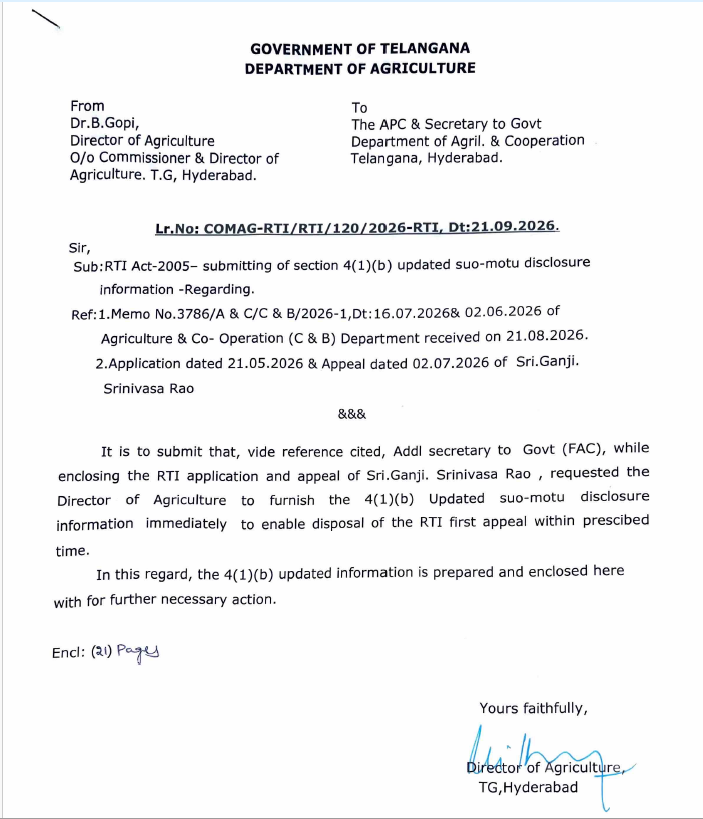
An updated suo-motu disclosure under Section 4(1)(b) of the RTI Act, 2005 has provided detailed information about the organisation, functions, responsibilities, schemes, regulatory activities, budget, public interaction and RTI authorities of the Telangana Agriculture Department.
The disclosure was submitted by Dr. B. Gopi, IAS, Director of Agriculture, Telangana, to the APC & Secretary to Government, Department of Agriculture & Cooperation, vide Letter No. COMAG-RTI/RTI/120/2026-RTI, dated September 21, 2026. The disclosure followed an RTI application and appeal filed by Ganji Srinivasa Rao.
What are the main functions of the Agriculture Department?
The department’s core responsibilities include providing agricultural extension services, transferring modern agricultural technology and know-how to farmers, conducting demonstrations and farmer training programmes, and assessing and regulating essential agricultural inputs.
These include seeds, fertilizers, pesticides, agricultural credit and farm implements.
The department also implements major State and Central Government programmes, including Rythu Bharosa, Rythu Bima, Crop Loan Waiver, RKVY, Natural Farming Mission, Pulses Mission, Oilseeds Mission and ATMA.
Other activities include soil testing, crop booking, farm mechanisation, crop-insurance monitoring, plant-protection diagnostic visits, Kisan Helpline Centres and IT-based agricultural initiatives.
Who works from the State level to the field level?
The Agriculture Department operates through a hierarchical administrative structure.
At the State level, the department is headed by the Commissioner & Director of Agriculture, supported by Additional Directors, Joint Directors, Deputy Directors, Assistant Directors and Agriculture Officers.
At the district level, the District Agriculture Officer (DAO) and ATMA Project Directors are responsible for administration and implementation.
At the division level, Assistant Directors of Agriculture (ADA) function as the responsible officers.
At the mandal level, Mandal Agricultural Officers (MAO) handle agricultural administration and services.
At the cluster/field level, Agriculture Extension Officers (AEOs) undertake field-level activities and interact with farmers.
This structure enables agricultural administration and services to operate from the State headquarters down to district, division, mandal and field levels.
Which agricultural inputs are regulated?
The Agriculture Department has important regulatory responsibilities concerning the quality and movement of agricultural inputs.
For seeds, the department implements provisions under the Seeds Act, 1966, Seed (Control) Order, 1983, Essential Commodities Act, 1955, Cotton Seed Act, 2007 and Environment Protection Act, 1986.
For fertilizers, the Fertilizer (Control) Order, 1985 and related regulations apply.
For pesticides, the Insecticides Act, 1968 is among the key laws governing regulation and quality control.
What laboratories and seed farms are operated?
The disclosure lists several facilities, including:
- Soil Testing Laboratories
- Bio-Pesticide Testing Laboratory
- DNA/FP Laboratory
- Fertilizer Coding/Control Laboratories
- Pesticide Testing Laboratories
- Seed Testing Laboratories
- Bacterial Production & Culture Laboratory
Seed farms are listed at Maltummeda, Boppaspally, Sadasivapet, Dindi, Cherukupally, Kaddam, Jullekal and Korivipadu.
Where can farmers and citizens submit grievances?
The disclosure states that members of the public can submit physical representations at the offices of the C&DA, DAO, ADA and MAO.
The listed helpline numbers include:
Fertilizer Booking App Toll-Free: 18001237157
GOI Kisan Helpline: 18001801551
The Telangana Farmer Welfare Commission, located at BRK Bhavan, Hyderabad, is also identified as an advisory body concerned with farmer welfare and sustainable profitability.
Who issues licences for seeds, fertilizers and pesticides?
The disclosure identifies the licensing authorities at different administrative levels:
- State level: C&DA
- District level: DAO
- Divisional level: ADA
These authorities deal with licences relating to transactions in seeds, fertilizers and pesticides.
What is the Agriculture Department’s 2026–27 budget?
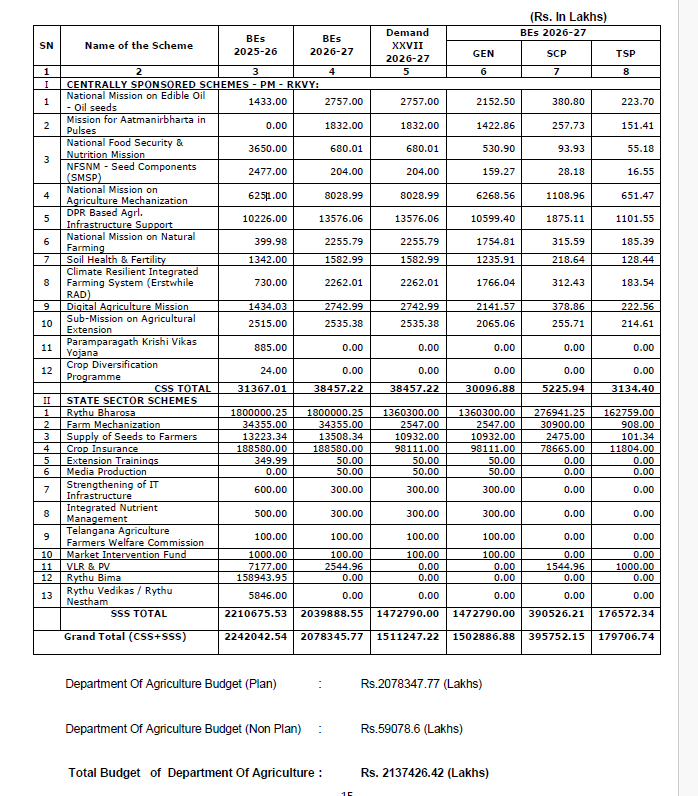
According to the disclosure, the overall department budget grand total for 2026–27 is ₹2,137,426.42 lakh.
The Centrally Sponsored Schemes (CSS) allocation under PM-RKVY is stated as ₹38,457.22 lakh, while the State Sector Schemes (SSS) total is ₹2,039,888.55 lakh.
Among the major State Sector allocations listed are:
- Rythu Bharosa: ₹1,800,000.25 lakh
- Crop Insurance: ₹188,580.00 lakh
- Rythu Bima: ₹158,943.95 lakh
- Farm Mechanization: ₹34,355.00 lakh
What are the pay scales of selected officers?
The disclosure provides the following pay-scale ranges for selected cadres:
| Cadre | Pay Scale |
| Additional Director | ₹66,330–₹1,08,330 |
| Joint Director | ₹56,870–₹1,05,810 |
| Deputy Director | ₹49,870–₹1,00,770 |
| Assistant Director | ₹40,270–₹93,780 |
| Agriculture Officer | ₹35,120–₹87,130 |
| AEO Grade-I | ₹29,760–₹80,930 |
The document identifies Dr. B. Gopi, IAS, as Director of Agriculture, and lists K. Vijay Kumar and B. Narasimha Rao as Additional Directors.
Who are the RTI authorities?
The Agriculture Department has identified specific authorities for dealing with RTI matters.
Appellate Authorities:
- K. Vijay Kumar – Administration
- B. Narasimha Rao – Technical
Public Information Officers (PIOs):
- M. Sachin Dutt, DDA – Administration
- S. Balu, JDA – Technical
Assistant Public Information Officers (APIOs):
- K. Sai Indira – Administration
- G. Jhansi – Technical
How many days should an application or grievance take to resolve?
For citizens, merely knowing the name of an office or officer is not enough. It is equally important to know which authority is responsible, what procedure applies, and within what time an application or service should be dealt with.
The Section 4(1)(b) disclosure provides substantial information about the department’s organisational structure, functions, officers and services. However, the specific time limit for disposal may depend on the particular service, application, applicable Act, rules, Government Orders or Citizen Charter.
Therefore, citizens should verify the applicable statutory or administrative time limit for the particular service or grievance rather than assuming that one common time limit applies to every matter.
Why is this information important?
Section 4(1)(b) of the RTI Act, 2005 promotes proactive disclosure of information concerning the organisation, functions, duties, powers, decision-making procedures, rules and other important aspects of public authorities.
The Agriculture Department’s updated disclosure can help farmers and citizens understand:
- Who is responsible for a particular agricultural service;
- Where an application or grievance can be submitted;
- Which officer has jurisdiction at State, district, divisional or mandal level;
- Which authorities regulate agricultural inputs;
- Where RTI applications and appeals can be directed;
- What schemes and programmes are administered by the department; and
- What public funds are allocated to major agricultural schemes.
Access to information helps citizens understand how government offices function and enables them to approach the appropriate authority and exercise their rights under the RTI Act, 2005.
Contact : gsrao@way2rti.com