RTI Reveals Revisions and Special-Fare Powers
TELANGANA : Why are ordinary passengers in Telangana repeatedly facing higher public transport fares while the availability of TGSRTC-owned buses is also a concern? Information obtained under the Right to Information Act, 2005, provides important details about fare revisions, the reasons cited by the Corporation and the legal framework governing special fares.
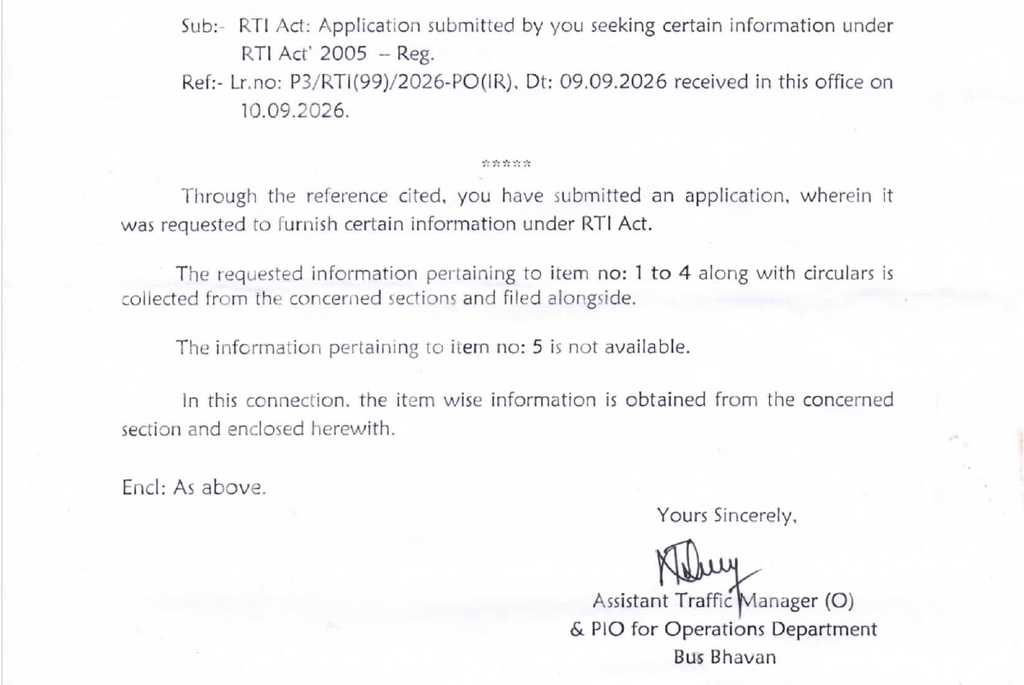
RTI activist Ganji Srinivasa Rao sought information from TGSRTC regarding bus fare hikes and special fares from June 2, 2014 to the present. The Public Information Officer furnished relevant records and circulars in response.
Fare hikes cited as a solution to financial losses
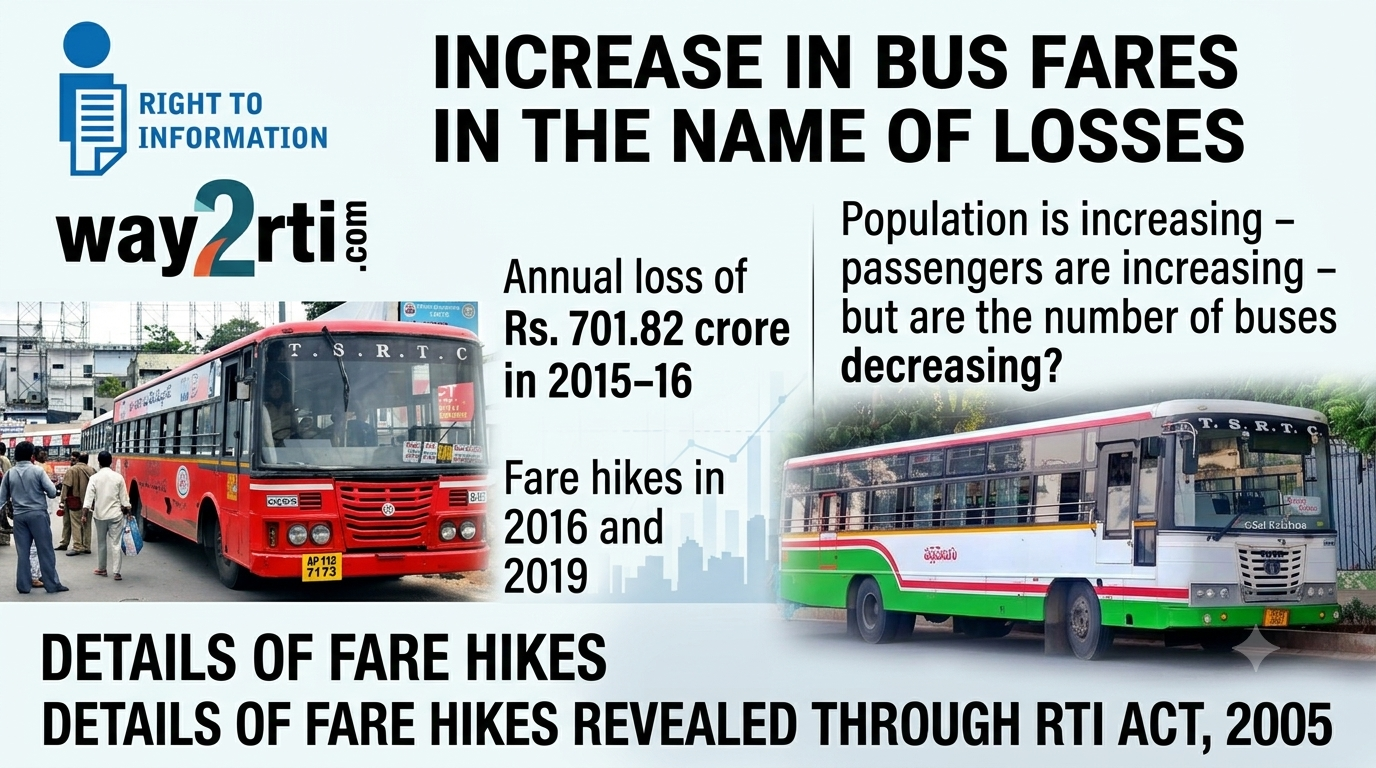
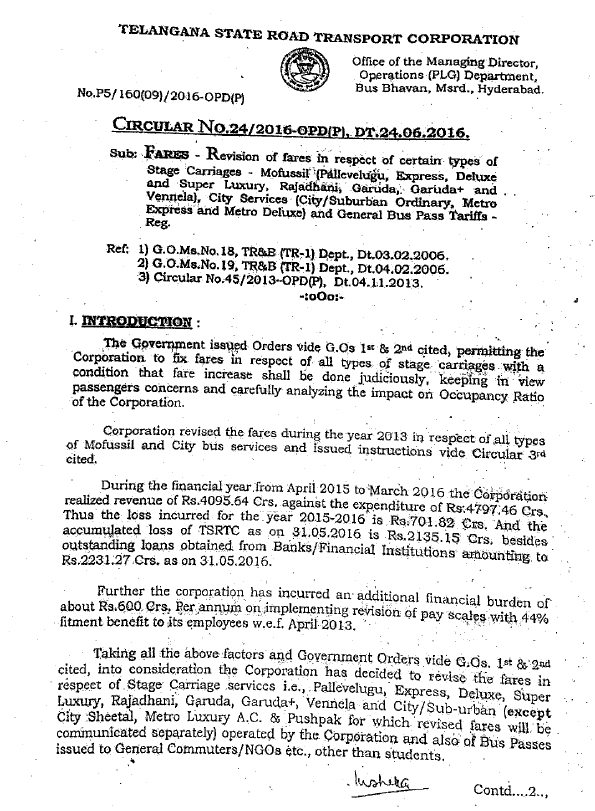
According to the RTI information, TGSRTC Circular No. 24/2016-OPD(P), dated June 24, 2016, revised fares for mofussil and city services. The Corporation cited substantial financial pressure during 2015–16: revenue of about ₹4,095.64 crore against expenditure of ₹4,797.46 crore, resulting in an annual loss of approximately ₹701.82 crore, apart from an additional salary-revision burden of around ₹600 crore annually.
The 2016 revision increased basic rates across several categories. For example, the Express fare increased from 79 paise to 87 paise per kilometre, Deluxe from 89 to 98 paise, Super Luxury from 105 to 116 paise, and Rajadhani AC from 132 to 146 paise per kilometre.
The next major revision disclosed in the RTI response was TGSRTC Circular No. 21/2019-OPD(P), dated December 1, 2019, effective from December 3, 2019. The Corporation cited rising HSD oil prices, implementation of interim relief and accumulated operating losses of approximately ₹928.67 crore during 2018–19. Basic fares were increased by 20 paise per kilometre across the services.
Fewer TGSRTC-owned buses, but more passengers and a growing population
Another important public-interest concern is the number of buses owned and operated by TGSRTC.
According to the information available to the RTI activist, TGSRTC had approximately 9,000 owned buses in 2015, whereas the number of TGSRTC-owned buses had reduced to only 6,588 as of August 2026.
This represents a substantial reduction in the Corporation’s own bus fleet.
At the same time, Telangana’s population and urbanisation have continued to increase, particularly in Hyderabad and surrounding municipalities. More people depend on public transport for employment, education, healthcare, business and daily travel.
This creates a fundamental question for the public:
If the population and passenger demand are increasing, why is the number of TGSRTC-owned buses reducing?
Passengers are already facing overcrowding, waiting times and inadequate services on several routes. If the availability of buses reduces while passenger demand increases, ordinary commuters ultimately bear the consequences through longer waiting periods, overcrowded buses and increased dependence on other modes of transport.
Fare increases and service availability
The issue therefore goes beyond the price of a bus ticket.
Passengers may reasonably ask:
- Why are fares increased when TGSRTC faces financial losses?
- What measures have been taken to improve operational efficiency?
- Why has the number of TGSRTC-owned buses reduced substantially?
- How many buses are actually required based on present passenger demand?
- How many buses are operational every day?
- What is the route-wise requirement and availability?
- What is the financial impact of operating private/hired buses compared with TGSRTC-owned buses?
- Are fare increases improving the quality and availability of public transport?
A fare increase may provide additional revenue, but higher fares alone cannot be the permanent solution to operational or financial problems if the underlying service capacity is simultaneously declining.
Special fares: a question for passengers
The RTI records also point to the statutory framework governing special fares. G.O.Ms.No.16, Transport, Roads & Buildings Department, dated February 3, 2003, prescribed maximum permissible fare rates under Section 67(1)(d)(i) of the Motor Vehicles Act, 1988.
The order also permits, under specified circumstances, charging up to 1.5 times the normal fare during special occasions, fairs, jatras and festivals.
This raises another public-interest question: when passengers already depend on public transport for daily travel, should financial losses and special operational requirements repeatedly translate into a higher financial burden on ordinary citizens?
Increasing population needs increasing public transport
Telangana is experiencing continuing population growth, urban expansion and increasing movement of people between villages, towns and cities.
Public transport should therefore be planned according to present and projected passenger demand, rather than merely the number of buses currently available.
If passenger demand increases but the owned fleet decreases, the Government and TGSRTC should publicly explain the reasons and disclose their plans for increasing bus availability.
More population + more passengers + fewer owned buses = greater pressure on the ordinary passenger.
This is a matter that deserves public debate and transparent disclosure.
Transparency is essential
The RTI response reportedly supplied information relating to Items 1 to 4 of the application, while information concerning press releases/notices under Item 5 was stated to be not available.
For citizens, complete and easily accessible fare-revision records are important. Passengers should be able to know when a fare was increased, by how much, under whose approval, on what financial or administrative grounds, and whether the fare remains within the applicable statutory framework.
Public transport is an essential service for students, employees, senior citizens, daily-wage workers and low-income families. Therefore, fare revisions should be accompanied by maximum transparency and accountability.
If fares are increased, citizens have a right to know the reasons. If the number of TGSRTC-owned buses has declined while population and passenger demand have increased, citizens also have a right to know why the fleet has reduced and what concrete steps are being taken to ensure adequate buses for the travelling public.
Public transport is not merely a business—it is an essential public service.